
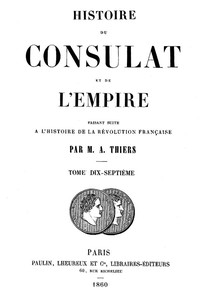
Histoire du Consulat et de l'Empire, (Vol. 17/20) by Adolphe Thiers
Most of us know the broad strokes: Napoleon Bonaparte, the brilliant and ambitious French emperor, meets his final defeat at the Battle of Waterloo in 1815. Roll credits. But history doesn't end with a dramatic battle scene. Adolphe Thiers’s Histoire du Consulat et de l'Empire, Volume 17 is all about the credits—and the complex, uncertain world that followed.
The Story
This volume covers the immediate aftermath of Napoleon's second abdication. The Allies have won, and they march into Paris. The book follows the frantic political maneuvering as France tries to form a new government under the returning Bourbon king, Louis XVIII. Meanwhile, the victorious powers—Britain, Russia, Prussia, Austria—gather to decide the fate of Europe. Thiers details the negotiations, the arguments over borders, the debates about punishing France, and the struggle to create a lasting peace. It's a story of diplomacy, fear, and exhaustion, as a continent exhausted by war tries to build something stable from the wreckage of the Napoleonic era.
Why You Should Read It
What makes this special is Thiers’s perspective. He wasn't just a historian looking back; he was a politician who knew many of the players personally. His writing has the feel of a well-informed insider’s account. You get a sense of the anxiety in the air—the fear of revenge, the worry about another revolution, the sheer relief mixed with uncertainty. He shows us that 'peace' isn't an event, but a fragile, complicated process. The characters aren't just statues; they're tired men making difficult compromises, trying to ensure the wars are truly over.
Final Verdict
This isn't a casual beach read, but it's incredibly rewarding for the right reader. It's perfect for history buffs who feel like they've read everything about Napoleon's battles and want to understand the consequential peace that shaped the 19th century. If you enjoy political drama, diplomatic history, or stories about rebuilding after a crisis, you'll find this volume gripping. Think of it as the essential, and often overlooked, final chapter to one of history's greatest dramas.
You are viewing a work that belongs to the global public domain. It is available for public use and education.
Thomas Williams
5 months agoThought-provoking and well-organized content.
Michael Thompson
1 year agoBefore I started my latest project, I read this and the concise summaries at the end of each section are a lifesaver. It cleared up a lot of the confusion I had previously.
Emily Moore
9 months agoRight from the opening paragraph, the structural organization allows for quick referencing of key points. The insights gained here are worth every minute of reading.
Kimberly Harris
2 years agoI started reading this with a critical mind, the nuanced approach to the central theme was better than I expected. The insights gained here are worth every minute of reading.






Margaret Hernandez
3 months agoI was particularly interested in the case studies mentioned here, the author manages to bridge the gap between theory and practice effectively. I'm glad I chose this over the other alternatives.