
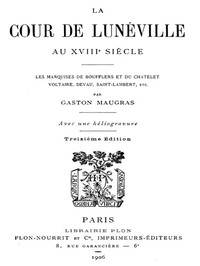
La Cour de Lunéville au XVIIIe siècle by Gaston Maugras
Gaston Maugras's La Cour de Lunéville au XVIIIe siècle invites us into a fascinating historical side-show. While Paris and Versailles dominated the era, the court of Lunéville, under the exiled Polish king Stanislas Leszczyński, created its own vibrant and peculiar microcosm.
The Story
This isn't a novel with a single plot, but a rich portrait of a place and time. Stanislas, father-in-law to Louis XV of France, was given the Duchy of Lorraine to rule. His court at Lunéville became a refuge for displaced Polish nobility, a hub for philosophers and writers like Voltaire (who had a famously turbulent stay), and a center for arts and lavish parties. Maugras structures his book like a guided tour. He introduces us to the key players, from Stanislas himself—a man of culture and melancholy—to the scheming courtiers, the artists seeking patronage, and the intellectuals debating new ideas. The 'narrative' is built from their interactions: the love affairs, the bitter rivalries, the extravagant festivals, and the constant, underlying tension of living in a political backwater while pretending it's the center of the universe.
Why You Should Read It
What makes this book special is its focus on atmosphere and character over dry facts. Maugras has a great eye for the telling detail—the snub at a dinner party that sparked a feud, the ridiculous cost of a masquerade ball, the quiet moments of homesickness. He makes you feel the texture of daily life in this gilded cage. You get a real sense of the insecurity buzzing beneath the silk and powdered wigs. These people were performing their importance every single day, and Maugras shows just how exhausting and often absurd that performance could be. It's history from the inside out, focusing on human motives rather than just political outcomes.
Final Verdict
This is a perfect read for anyone who loves historical gossip and vivid settings. If you enjoyed the courtly intrigue in a show like The Great or a book like Wolf Hall, but prefer real history, you'll fall right into Lunéville's world. It's also great for travelers interested in French history beyond the classic tourist trail. Fair warning: it assumes a basic familiarity with 18th-century European history. But if you're willing to dive in, Maugras offers a captivating, intimate, and often witty look at a forgotten corner of the Enlightenment, proving that sometimes the most interesting stories happen far from the throne room.
This work has been identified as being free of known copyright restrictions. It is available for public use and education.
Linda Moore
8 months agoAfter a thorough walkthrough of the table of contents, the formatting on mobile devices is surprisingly crisp and clear. I appreciate the effort that went into this curation.
Margaret Jones
10 months agoMy first impression was quite positive because the historical context mentioned in the early chapters is quite enlightening. I'll be recommending this to my students and colleagues alike.
Charles Jones
1 year agoI've gone through the entire material twice now, and the objective evaluation of the pros and cons is very refreshing. If you want to master this topic, start right here.
John Jackson
11 months agoGiven the current trends in this field, the chapter on advanced strategies offers insights I haven't seen elsewhere. I am looking forward to the author's next publication.





Thomas Jones
1 year agoHaving explored several resources on this, I find that the step-by-step breakdown of the methodology is extremely helpful for students. I'm genuinely impressed by the quality of this digital edition.