
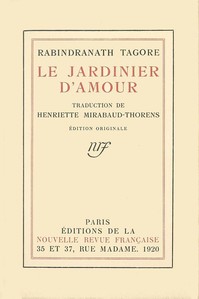
Le jardinier d'amour by Rabindranath Tagore
Let's clear something up first: this isn't a novel. 'Le jardinier d'amour' is a collection of lyrical poems translated into French. Tagore, who won the Nobel Prize in Literature, writes here as a gardener tending to the most fragile and powerful of blooms: human love.
The Story
There isn't a linear plot. Instead, Tagore gives us a series of emotional scenes. Imagine walking through a garden at different times of day. One poem captures the giddy, hopeful sunrise of new love. Another sits in the weary afternoon heat of longing and doubt. A third finds peace in the moonlight of quiet devotion. The 'gardener' is the lover, and the poems are his labors—his songs, his questions, his offerings. He speaks to a beloved who is sometimes present, often absent, but always the center of his world. It's about the work of love: the planting, the watering, the waiting, and sometimes, the acceptance of what does not grow.
Why You Should Read It
I picked this up thinking it would be grand and romantic. It is, but not in a flashy way. Its power is in its simplicity. Tagore strips love down to its raw elements. These poems don't just celebrate love's joy; they sit with its loneliness, its insecurity, and its quiet sacrifices. My favorite moments are the questions: "Have you not heard his silent steps? He comes, comes, ever comes." That constant 'coming'—is it hope or anxiety? Both, I think. It made me realize how much of love is lived in the anticipation, in the space between heartbeats. The language (even in translation) feels like music. It's direct, image-rich, and hits you right in the chest.
Final Verdict
Perfect for anyone who thinks poetry is 'too difficult.' This is your gateway. It's also for the quiet romantics, the overthinkers, and anyone who has ever loved someone and felt both enlarged and completely vulnerable because of it. Keep it on your nightstand. Don't rush it. Read one or two poems at a time, let them breathe, and see which ones take root in you. It's a small book that asks the biggest questions about the heart.
This title is part of the public domain archive. Distribute this work to help spread literacy.
Susan Rodriguez
1 year agoThis digital copy caught my eye due to its reputation, the breakdown of complex theories into digestible segments is masterfully done. A solid investment for anyone's personal development.
Michael Thomas
7 months agoThis digital copy caught my eye due to its reputation, the step-by-step breakdown of the methodology is extremely helpful for students. A refreshing and intellectually stimulating read.
John Thompson
10 months agoAs someone working in this industry, I found the insights very accurate.
Karen Miller
2 months agoClear, concise, and incredibly informative.






William Garcia
1 month agoThis is now a staple reference in my professional collection.