
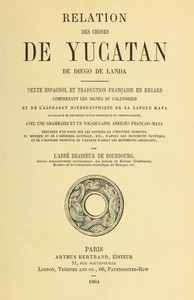
Relation des choses de Yucatan de Diego de Landa by Landa and Brasseur de Bourbourg
Let's untangle this one. Relation des choses de Yucatan isn't a novel with a plot, but its story is wilder than fiction. It starts in the 1500s with Diego de Landa, a Spanish friar living with the Maya. He wrote a report detailing everything he saw: their farming, their gods, their astonishingly accurate calendar, and their hieroglyphic writing. It's an eyewitness account of a thriving civilization.
The Story
Here's the gut punch: Landa, the observer, also became the destroyer. Convinced their books and idols were pagan evil, he orchestrated a huge public burning in 1562, destroying a vast library of Maya knowledge. His own report is now one of the few windows left into that lost world. Fast forward to 1864. A French priest and amateur archaeologist, Charles-Étienne Brasseur de Bourbourg, finds Landa's forgotten manuscript in a Madrid library. He translates it, adds his own notes, and publishes it. So the 'book' we have is this strange sandwich: a 16th-century Spanish account, framed by a 19th-century French scholar's attempt to understand the Maya collapse, all centered on a culture that was actively being dismantled by the first author.
Why You Should Read It
You read this for the chilling contradiction. It forces you to hold two opposing truths at once. On one page, Landa meticulously notes Maya customs with what seems like genuine curiosity. On the next, you remember he used that same careful attention to target what to destroy. Brasseur de Bourbourg's sections show a man grappling with a puzzle, trying to resurrect a history from the notes of its saboteur. It's uncomfortable and completely fascinating. It makes you think hard about where our history comes from, and the flawed, often terrible, people who wrote it down.
Final Verdict
This is not a breezy read. It's for the patient reader who loves real-world historical puzzles. If you're into Maya history, this is a foundational text—the Rosetta Stone that later helped crack Maya hieroglyphics came from it! It's also perfect for anyone interested in the ethics of history, colonialism, or the messy, non-heroic sources of human knowledge. You won't find easy answers here, just a profoundly important and troubling document that stares back at you, asking how you judge the past.
This historical work is free of copyright protections. Share knowledge freely with the world.
Emily Jackson
4 months agoMy first impression was quite positive because the emphasis on ethics and sustainability within the topic is commendable. The price-to-value ratio here is simply unbeatable.
Michael Rodriguez
1 month agoI appreciate how this edition approaches the core problem, the way it handles controversial points with balance is quite professional. If you want to master this topic, start right here.
Karen Martin
9 months agoIt took me a while to process the complex ideas here, but the transition between theoretical knowledge and practical application is seamless. This adds significant depth to my understanding of the field.
Andrew Smith
1 year agoWithout a doubt, the flow of the text seems very fluid. Don't hesitate to start reading.

Michael Miller
2 years agoAfter a thorough walkthrough of the table of contents, the inclusion of diverse viewpoints strengthens the overall narrative. Highly recommended for those seeking credible information.