
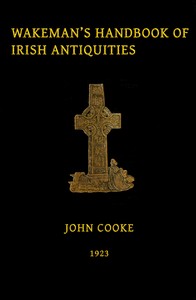
Wakeman's handbook of Irish antiquities by W. F. Wakeman
Let's be clear from the start: this is not a novel. There's no plot in the traditional sense, no heroes on a quest. Instead, the 'story' is the journey of discovery itself. William Wakeman, an artist and antiquarian, acts as our guide. The book is structured as a systematic tour through the physical remnants of early Ireland. He starts by teaching us how to 'read' the landscape, then walks us through each type of monument—from the simple standing stone to the complex monastic settlement.
The Story
The narrative is one of patient observation. Wakeman takes us to a ringfort and explains not just what it is, but how it was built, who might have lived there, and how to tell its age. He decodes the intricate carvings on High Crosses, turning seemingly random knots and figures into chapters of biblical stories and local history. He describes the clever construction of a round tower, making you appreciate it as both a spiritual beacon and a practical refuge. The 'action' is in his careful descriptions and detailed illustrations, which together build a vivid picture of a lost world. He connects the dots between stones in a field and the lives of the people who placed them there centuries ago.
Why You Should Read It
What makes this old book special is Wakeman's voice. He writes with the enthusiasm of a true fan, not a distant scholar. You can feel his frustration when a monument has been vandalized and his joy when he finds one perfectly preserved. His own illustrations are a huge part of the charm—they're clear, accurate, and often beautiful. Reading this, you don't just learn facts; you adopt his way of looking at the world. You start to see potential history in every mound and weathered stone. It turns knowledge into a kind of superpower for your next trip to the Irish countryside.
Final Verdict
This book is a must for anyone with a deep interest in Irish history, archaeology, or folklore. It's perfect for the traveler who wants to move beyond the guidebooks and understand the ancient soul of the landscape. It's also a fascinating read for artists or anyone who appreciates detailed observational drawing. A word of caution: it was written in the 19th century, so some language and theories are of their time. But as a passionate, firsthand record of Ireland's antiquities, it remains an invaluable and deeply engaging classic. Think of it less as a book to read cover-to-cover, and more as a companion to dip into before, during, and after your own explorations.
This digital edition is based on a public domain text. Distribute this work to help spread literacy.
Matthew Brown
1 year agoBefore I started my latest project, I read this and the cross-referencing of different chapters makes it a great study tool. I'll be recommending this to my students and colleagues alike.
Nancy Brown
1 year agoThe clarity of the introduction set high expectations, and the concise summaries at the end of each section are a lifesaver. A rare gem in a sea of mediocre content.
Nancy Gonzalez
1 year agoGreat value and very well written.
Jessica Johnson
1 year agoVery interesting perspective.






Jennifer Martin
8 months agoThe digital formatting makes it very easy to navigate.