
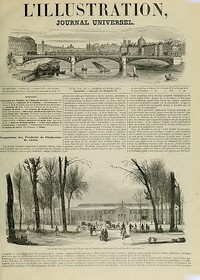
L'Illustration, No. 0056, 23 Mars 1844 by Various
Let's be clear from the start: this is not a novel. It's a weekly French magazine from March 23, 1844, and reading it is like attending the world's most eclectic dinner party. You get a bit of everything, served up with the earnestness and occasional strangeness of the era.
The Story
There is no single narrative. Instead, the 'story' is the week of March 23rd itself. The lead item is serious journalism: a detailed account of the parliamentary speeches for and against abolishing slavery. The tension is palpable. Then, the mood shifts completely to wonder, with lavish illustrations and descriptions of the Gare de Lille, a cathedral to the industrial age. You get the next chapter of a swashbuckling serialized novel, Les Nuits de la Seine. There's a travel piece from recently colonized Algeria, painting a romanticized picture for the home audience. And sprinkled throughout are oddities: fashion notes, a review of a new play, and that earnest promotion of donkey's milk for curing ailments. It's a wild, uncurated mix of news, entertainment, and propaganda.
Why You Should Read It
I love this because it has no filter. History books summarize and analyze for us. This is the primary source, in all its glorious mess. You see what the editors chose to highlight (the slavery debate, the train station) and what they casually accepted (the colonial viewpoint). The engravings alone are worth it—they were the Instagram of their day, and you can spend ages studying the details of clothing, architecture, and technology. Reading it, you stop seeing the 1840s as a monolith of 'olden times' and start to feel its energy, its contradictions, and its daily rhythms. It makes history feel immediate and surprisingly human.
Final Verdict
Perfect for history buffs who are tired of textbooks, for writers seeking authentic period flavor, or for any curious reader who enjoys a good digital rabbit hole. It's not a cover-to-cover read, but a browse-and-absorb experience. Think of it as the most educational and fascinating magazine you'll ever pick up, even if it's 180 years out of date. Just be ready for some jarring moments—it's a raw look at the past, not a polished one.
This book is widely considered to be in the public domain. Preserving history for future generations.
Nancy Moore
10 months agoBefore I started my latest project, I read this and the formatting on mobile devices is surprisingly crisp and clear. I'm glad I chose this over the other alternatives.
Linda Thomas
2 years agoThe clarity of the introduction set high expectations, and the author doesn't just scratch the surface but goes into meaningful detail. A rare gem in a sea of mediocre content.
Susan Anderson
1 year agoThe methodology used in this work is academically sound.
Jessica Miller
2 months agoThis was exactly the kind of deep dive I was searching for, the emphasis on ethics and sustainability within the topic is commendable. I'll be citing this in my upcoming project.



Charles Brown
2 months agoThe analytical framework presented is both innovative and robust.