
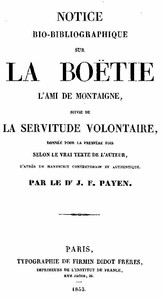
Notice bio-bibliographique sur La Boëtie, suivie de La Servitude volontaire
This book is really two in one. The first half is a 'bio-bibliographical notice'—a fancy term for a life story. It tells the tale of Étienne de La Boétie, a legal scholar and poet in 1500s France. He was a prodigy, known for his sharp mind and integrity. His most famous act, strangely, was forming an intense, legendary friendship with the writer Michel de Montaigne. Their bond was so profound that Montaigne's most famous essays were born from his grief after La Boétie's sudden death from illness at age 32.
The Story
The second half is the main event: La Boétie's essay, 'Discourse on Voluntary Servitude' (or 'The Politics of Obedience'). He wrote it when he was probably still a teenager. There's no traditional plot with characters. Instead, it's one long, compelling argument. La Boétie asks a simple, brutal question: Why do millions of people obey one ruler who holds all the power? His answer is even more startling: because we choose to. He argues that tyrants have no real power except what we give them through our consent, our habits, and our fear. If everyone simply stopped obeying, the ruler's power would vanish overnight. The essay walks through how people are manipulated into compliance, from spectacle and rewards to sheer routine.
Why You Should Read It
You should read this because it feels illegal. It’s not a dry philosophical text; it’s a protest pamphlet that crackles with youthful anger and clarity. Reading it, you realize how little the mechanics of power have changed in 500 years. The way La Boétie describes people trading their freedom for a little security or distraction feels painfully familiar in our modern world of social media, politics, and consumer culture. It makes you the reader an accomplice, asking: 'In what ways do I accept my own servitude every day?' It’s a short, potent shot of intellectual adrenaline.
Final Verdict
This is perfect for anyone who loves big ideas packed into a small space. If you enjoy authors like George Orwell or Hannah Arendt, you’ll find their intellectual ancestor here. It's also great for book clubs—the essay is guaranteed to spark fierce debate. History buffs will appreciate the context of the biography, but the essay itself is for everyone: the curious, the skeptical, and anyone who has ever asked, 'Why do we put up with this?' Just be warned: it might ruin your ability to take the status quo for granted.
You are viewing a work that belongs to the global public domain. It is now common property for all to enjoy.
David Harris
1 year agoComprehensive and well-researched.
Patricia Williams
1 year agoIf you enjoy this genre, it provides a comprehensive overview perfect for everyone. Highly recommended.




Matthew Miller
1 year agoI came across this while browsing and the author's voice is distinct and makes complex topics easy to digest. One of the best books I've read this year.