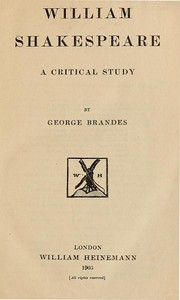
William Shakespeare: A Critical Study by Georg Brandes
Let's be honest: most books about Shakespeare can feel like homework. They're full of dense analysis and academic jargon. Georg Brandes' book is different. Published in 1895, it was a sensation because it did something radical: it treated Shakespeare not as a distant god of literature, but as a flesh-and-blood man living in a specific, turbulent time.
The Story
This isn't a story with a plot in the usual sense. Instead, Brandes builds a psychological and historical narrative. He walks us through Shakespeare's life chronologically, from his childhood in Stratford to his death as a wealthy gentleman. But the real focus is on the connection between the life and the work. Brandes shows us how the political anxieties of Queen Elizabeth's court might have shaped the history plays. He suggests how personal loss could have fueled the tragedies. He argues that Shakespeare's incredible understanding of human nature came not from divine inspiration, but from a sharp-eyed observation of the ambitious, flawed, and passionate people all around him in London's theaters and taverns. The 'story' Brandes tells is how a brilliant, pragmatic artist navigated his world and transformed his experiences into art.
Why You Should Read It
I loved this book because it made Shakespeare feel real. Brandes removes the myth and gives us a person. We see Shakespeare the careful businessman, securing his family's wealth. We see the ambitious writer, borrowing plots and making them uniquely his own. We see an artist deeply engaged with the big questions of power, love, jealousy, and madness that defined his era—and still define ours. Reading this, you start to see the plays not as isolated masterpieces, but as chapters in one man's ongoing conversation with his world. It gives context to the famous soliloquies and sonnets in a way that makes them hit harder.
Final Verdict
This is the perfect book for anyone who finds Shakespeare intimidating or just wants to understand him better. It's for the reader who enjoys historical biography, true crime-style investigations into the past, or just a great human story. You don't need a literature degree; you just need curiosity about one of history's most fascinating figures. Fair warning: it's over a century old, so some of Brandes' views feel dated. But that's part of the fun—you're seeing how a brilliant mind from the 1890s solved the puzzle of Shakespeare. It's a classic for a reason, and it still has the power to surprise and enlighten.
Legal analysis indicates this work is in the public domain. Distribute this work to help spread literacy.