1

Billy Whiskers, Jr. — Reading Notes
(0 User reviews)
150
Project Gutenberg
2021
Not confirmed
Dogs -- Juvenile fiction; Animals -- Juvenile fiction; Adventure stories; Friendship -- Juvenile fiction; Indians of North America -- Juvenile fiction; Voyages and travels -- Juvenile fiction; Goats -- Juvenile fiction; Mexico -- Juvenile fiction; West (U.S.) -- Juvenile fiction; Human-animal relationships -- Juvenile fiction
Readers of public-domain and historical texts
Project Gutenberg digital edition
en
Edition facts
Words
34,598
Reading time
151 min
Text sections
24
Before opening Billy Whiskers, Jr. — Reading Notes, the edition data offers a quick orientation: 34,598 words, 2 hr 31 min estimated reading time, and 24 detected text sections.
The text analysis averages about 23.4 words per sentence, while the detected sections provide another way to judge how the source is divided.
Project Gutenberg metadata also associates the work with “Dogs -- Juvenile fiction,” connecting these edition facts with the source record’s subject description.
Source:
Project Gutenberg record #66006
This editorial note examines how the opening dialogue between goats Night and Day, a bullfight scene, and a chaotic reception episode shape a first reading of Billy Whiskers, Jr., highlighting the animal characters' distinct voices and the episodic structure.
Read the complete public-domain text at its original source.
Read on Project GutenbergThe story begins not with action but with a conversation between two goats, Night and Day, who speak in a blend of farmyard practicality and romantic fancy. Night complains that the quiet life is driving him mad, while Day blushes at the attention of a handsome goat with long horns. This opening immediately establishes that the animals possess distinct personalities and emotional lives, and that their adventures will be driven by character rather than mere plot. The dialogue is playful and colloquial, with Night teasing his sister about love and declaring his need for scrapes. Readers are thus oriented to expect a tale where animal voices and relationships matter as much as the events themselves.
Animal Voices and Human Concerns
The excerpts reveal that Montgomery gives her animal characters a vocabulary that mixes pastoral simplicity with surprisingly sophisticated social awareness. When Billy Jr. wanders into a reception, he understands that gaslight is used because complexions look better by it, and he recognizes the scent of flowers as reminiscent of clover. This blend of goat instincts and human knowledge creates a comic tension: Billy is both a genuine animal and a creature who can read social cues. The narration also shifts between Billy’s perspective and that of the human guests, who see him as a fearsome beast—a lion-sized bear—while Billy himself is simply hungry and tired. This double vision invites readers to sympathize with the goat even as they laugh at the chaos he causes.
Episodic Structure and Sudden Escapes
The table of contents lists eighteen chapters with titles like “The Collision,” “A Fight with Wolves,” and “The Bull-Fight,” suggesting a picaresque series of encounters rather than a single sustained plot. The excerpts bear this out: Billy moves from a farm to a firehouse to a reception to a street confrontation with boys and a dog, each episode ending with a narrow escape. The bullfight chapter is mentioned but not excerpted, yet the pattern is clear—Billy is always on the move, and his escapes often involve physical comedy, such as upsetting a fat butler or leaping ahead of a dog. This structure rewards readers who enjoy quick, self-contained adventures, and it means that the book can be sampled in short sittings.
The Role of the Illustrations
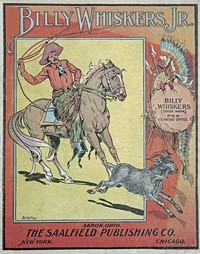
The frontispiece caption “He Rushed upon the Treacherous Indian” and the list of six illustrations (including “There Was a Terrific Explosion” and “Billy Gave One Leap Which Carried Him Ahead of the Dog”) indicate that the pictures are placed at dramatic moments. The illustrator, W. H. Fry, likely emphasizes action and expression. In the reception scene, the text describes Billy standing in the middle of a four-poster bed, and the corresponding illustration (page 80) shows him leaping ahead of a dog. These images would have helped early readers visualize the goat’s size and the slapstick nature of his adventures. For a modern reader, the illustrations offer a clue to the tone: the book is meant to be exciting but not frightening, with the goat always emerging triumphant.
Language and Period Details
Montgomery’s prose is brisk and occasionally formal, with phrases like “the fair five hundred” and “self-convicted” that reflect the book’s 1904 publication. The dialogue mixes rustic speech (“I like to get into scrapes just for the fun of getting out of them”) with more elaborate constructions. The setting shifts from a farm to a city reception to a bullfight in Mexico, and the catalog subjects include Indians of North America and the West, suggesting that Billy’s travels take him through varied landscapes. Readers should note that the book uses period-typical language about Native Americans and other cultures; the excerpts do not reveal how these are handled, but the chapter titles and subjects indicate they are part of the adventure.
Because the excerpts cover only the opening and a later episode, the full arc of Billy’s journey remains unknown. However, the consistent pattern of escape and the goat’s confident, mischievous voice suggest that the book maintains a light, comic tone throughout. Readers who enjoy animal stories with a strong narrative voice and episodic structure will find much to appreciate. Pay attention to how Montgomery balances Billy’s animal nature with his almost-human reasoning—this tension is the engine of the comedy.
The rain tapped the window while Billy Whiskers, Jr. bickered with Night and Day, their stubborn goat-voices filling the room. Afterwards, a quieter yearning lingered, for woods less boisterous, more secretive. That other book sat waiting, its cover dust-covered, and I found myself wandering into the Canadian forest with Lady Mary instead, following a slower, more patient kind of quiet. Lady Mary and Her Nurse; Or, A Peep into the Canadian Forest — Text and Context felt like shelter from all that noise.
There are no reviews for this eBook.
There are no comments for this eBook.
Reader reflection
Before you leave, reflect on the book
Use these questions to collect your thoughts before moving on.
Your progress
0
/
10
2
How much did you enjoy the reading experience?
3
Would you encourage someone else to read it?
4
What was the reading difficulty like?
5
Was the book what you thought it would be?
6
Which aspect of the book did you value most?
7
Is this a title worth rereading?
8
How did the pace of the book feel?
9
What changed or sharpened your thinking?
10