
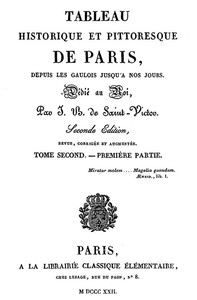
Tableau historique et pittoresque de Paris depuis les Gaulois jusqu'à nos jours…
This isn't a novel with a plot, but it has a powerful story to tell. "Tableau historique et pittoresque de Paris" is a monumental, multi-volume history and guide. Written by Jacques-Benjamin de Saint-Victor in the early 19th century, its mission is to paint a complete picture of Paris. He starts with the city's earliest days as a Gallic settlement and marches right through to the Paris of his own lifetime.
The Story
Think of it as the ultimate deep dive. Saint-Victor organizes his work like a grand tour. He leads you through different districts, pointing out famous landmarks like Notre-Dame or the Louvre, but also lesser-known alleys and squares. For each place, he layers on the history: what happened there, who lived there, how it changed. He describes buildings, public life, and customs. The 'pittoresque' (picturesque) part is key—he wants you to see and feel the city, not just memorize dates. The book is filled with illustrations that bring these descriptions to life. The central narrative is the city itself, surviving wars, revolutions, and kings, constantly being torn down and rebuilt.
Why You Should Read It
What makes this special is the author's perspective. Saint-Victor was writing in the aftermath of the French Revolution and the Napoleonic era, a time of massive physical and social change in Paris. You can feel him trying to make sense of it all, to preserve what was being lost to modernization. Reading it, you get a double history: the story of Paris from ancient times, and the story of how a post-revolutionary writer saw his own city's past. It's personal. You're not just learning about a bridge; you're learning why that bridge mattered to the people crossing it 200 years ago.
Final Verdict
This is a treasure for a specific kind of reader. It's perfect for history buffs who want to go beyond battles and politics into the streets of a living city. It's a must for Parisphiles who dream of knowing every corner of the City of Light. And it's fascinating for anyone who loves the idea of 'place' and how our surroundings hold memory. Be warned: it's a big, dense work. But if you dip in and out, letting Saint-Victor be your guide, you'll find a captivating and deeply human portrait of one of the world's great cities, written at a pivotal moment in its long life.
This is a copyright-free edition. Share knowledge freely with the world.
Susan Johnson
10 months agoI particularly value the technical accuracy maintained throughout.
Joseph Miller
4 months agoExtremely helpful for my current research project.
Charles Moore
9 months agoFrom a researcher's perspective, the language used is precise without being overly academic or confusing. I feel much more confident in my knowledge after finishing this.
Sarah Williams
6 months agoOne of the most comprehensive guides I've read this year.









Margaret Wilson
2 months agoBefore I started my latest project, I read this and the evidence-based approach makes it a very credible source of information. An excellent example of how quality digital books should be formatted.