1

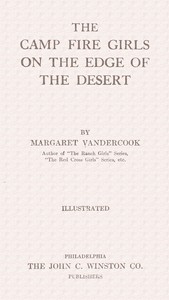
The Camp Fire Girls on the edge of the desert — Key Ideas to Explore
(0 User reviews)
84
Project Gutenberg
2024
Not confirmed
Western stories; Adventure stories; Camp Fire Girls -- Juvenile fiction; Girls -- Juvenile fiction; Girls -- Societies and clubs -- Juvenile fiction; Deserts -- Juvenile fiction; Arizona -- Description and travel -- Juvenile fiction; Hopi Indians -- Juvenile fiction
Readers of public-domain and historical texts
Project Gutenberg digital edition
en
Edition facts
Words
51,017
Reading time
222 min
Text sections
24
This digital edition of The Camp Fire Girls on the edge of the desert — Key Ideas to Explore is described by source-level measurements including 51,017 words, 3 hr 42 min estimated reading time, and 24 detected text sections.
The text analysis averages about 17.5 words per sentence, while the detected sections provide another way to judge how the source is divided.
Project Gutenberg metadata also associates the work with “Western stories,” connecting these edition facts with the source record’s subject description.
Source:
Project Gutenberg record #72632
This editorial note examines how Margaret Vandercook uses ceremonial dress, desert landscapes, and cross-cultural encounters to structure the narrative, focusing on the opening campfire scene and Bettina's rescue by a Hopi runner.
Read the complete public-domain text at its original source.
Read on Project GutenbergThe novel opens with a striking tableau: a girl in ceremonial Camp Fire dress sits alone by a dying fire, a torch bearer with a band of gold braid and an emblem of ascending smoke. The scene is static, almost ritualistic, as she reads aloud from a penciled poem. This image establishes a pattern of stillness and motion that recurs throughout the excerpts—the quiet of the campfire contrasts with the sudden action of Bettina's disappearance and rescue. The narrative moves between intimate, reflective moments and swift, physical movement, often across desert terrain.
Ceremonial Dress as a Structural Motif
The Camp Fire costume is more than a uniform; it functions as a visual anchor that signals shifts in setting and social context. In the opening chapter, the torch bearer's dress is described in precise detail—gold braid, orange and red flame colors, white smoke emblem—linking her to the fire and to the organization's ideals. Later, when Bettina wakes in the Hopi village, she wears only part of her costume: riding trousers and boots, an 'original departure' for Arizona camping. This partial dress marks her as both an insider (a Camp Fire Girl) and an outsider (adapting to the desert). The contrast between the full ceremonial garb and the practical adaptation underscores the tension between the girls' Eastern origins and their Western adventure.
The Desert as a Character in Motion
Vandercook uses the desert landscape to create a sense of vastness and danger that drives the plot. The excerpts mention 'the Painted Desert,' 'Sunset Pass,' and 'Cottonwood Creek,' but the desert is not just a backdrop—it is an active force. Bettina's rescue involves a twenty-mile journey across this terrain, and the narrative emphasizes the 'beauty and strangeness' of the scene, the 'glory of color in the sky,' and the sounds of coyotes and prairie wolves. The desert's scale isolates characters and forces encounters, such as Bettina's meeting with the Hopi runner. The movement between the girls' camp and the Indian village is a journey across both physical and cultural boundaries.
Cross-Cultural Encounters and the Hopi Runner
The Hopi character, Se-kyal-ets-tewa, is introduced through a series of contrasts: he is a college-trained athlete who has won a national running championship, yet he appears in traditional dress and speaks with quiet dignity. Bettina recognizes him from a train journey, but he does not initially recognize her. This delayed recognition creates a layered encounter—the reader sees him first through Indian customs (the Snake ceremony, the runner's endurance) and then through his 'quiet and well-bred' manner. Vandercook avoids simple stereotypes by showing his dual identity: he is both a modern American and a member of his nation. The rescue itself—carrying Bettina for miles—demonstrates physical prowess, but the dialogue emphasizes his courtesy and restraint.
The Role of Sound and Silence
The excerpts are punctuated by moments of quiet and sudden noise. The opening campfire scene is silent except for the girl's whispered reading. In the Hopi village, Bettina hears 'the peculiar bark of the coyote' and the 'short, quick yelp of the prairie wolf.' These sounds mark the passage of time and the alienness of the setting. The Indian woman Nampu moves 'quite noiselessly,' and the runner's approach is first heard as 'the sound of some one approaching' before he appears. Vandercook uses auditory cues to build tension and to signal transitions between scenes—from the stillness of the hut to the activity of the camp. The contrast between the girls' familiar voices and the unfamiliar desert sounds reinforces their displacement.
Readers attentive to Vandercook's use of costume, landscape, and sensory detail will find a narrative that moves between the ceremonial and the practical, the familiar and the strange. The excerpts suggest a story less concerned with plot mechanics than with the experience of being caught between two worlds—the structured world of the Camp Fire Girls and the open, unpredictable desert. The editorial note encourages noticing how small details, like a partial uniform or a coyote's bark, carry the weight of the novel's themes.
I’ve often lingered over that Hopi runner’s quiet arrival in the desert fireside, the way ceremonial detail signals belonging. It reminds me of another border watch, where a lad scans the dark for signals—each book holding a patient, watchful heart. Perhaps that’s the kinship: both find their anchor in vigilance. Tom Swift and His Great Searchlight; or, on the border for Uncle Sam — Key Ideas to Explore shares that tender, steadfast gaze.
There are no reviews for this eBook.
There are no comments for this eBook.
Reader reflection
Record your reading impressions
A brief reflection can help important ideas stay with you longer.
Your progress
0
/
10
2
How did the book work for you overall?
3
How likely are you to recommend this book?
4
How demanding did the text feel?
5
Would you start a conversation about this book?
6
How strongly did the book affect you emotionally?
7
Did anything about the book feel genuinely new?
8
Would you read this book again?
9
Which lesson or insight stayed with you?
10