1

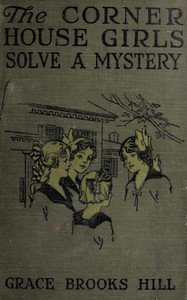
The Corner House Girls Solve a Mystery What It Was, Where It Was, and Who Found It — Inside the Classic
(0 User reviews)
419
Project Gutenberg
2020
Not confirmed
Treasure troves -- Juvenile fiction; Mystery and detective stories; Sisters -- Juvenile fiction; Families -- Juvenile fiction; Chinese -- Juvenile fiction; Brigands and robbers -- Juvenile fiction; Alligators -- Juvenile fiction
Readers of public-domain and historical texts
Project Gutenberg digital edition
en
Edition facts
Words
54,541
Reading time
238 min
Text sections
29
Before opening The Corner House Girls Solve a Mystery What It Was, Where It Was, and Who Found It — Inside the Classic, the edition data offers a quick orientation: 54,541 words, 3 hr 58 min estimated reading time, and 29 detected text sections.
The text analysis averages about 12.4 words per sentence, while the detected sections provide another way to judge how the source is divided.
Project Gutenberg metadata also associates the work with “Treasure troves -- Juvenile fiction,” connecting these edition facts with the source record’s subject description.
Source:
Project Gutenberg record #62489
This editorial note examines how the opening kitchen scene, the cryptic notes from Hop Wong, and the midnight summons guide a first reading of Grace Brooks Hill's 1923 mystery, focusing on the sisters' domestic routines, the Chinese laundryman's broken English, and the escalating suspense.
Read the complete public-domain text at its original source.
Read on Project GutenbergThe novel begins not with a crime but with cake batter. In the first chapter, Tess and Dot Kenway are baking in the kitchen when Sammy Pinkney bursts in, nearly causing a spill. The scene establishes the sisters' domestic competence—Tess manages the oven, Dot pours batter—and their irritation at interruptions. This homely setting contrasts sharply with the mystery that soon involves a Chinese laundryman, cryptic notes, and a midnight rendezvous. The opening suggests that the Corner House girls' ordinary lives will be disrupted by something foreign and puzzling.
Baking and Boundaries: The Kitchen as a Stage
The opening chapter grounds the story in the Kenway kitchen, where Tess and Dot assert control over their baking. Tess's rebuke to Sammy—"don't holler like that again"—and Dot's shriek when batter spills show the sisters defending their domestic space. The cakes they make are individual projects, each sister claiming ownership. This detail hints at the girls' independence and their ability to manage crises, a trait that will be tested later. The kitchen, with its oven and bowls, is a safe, familiar setting that will be contrasted with the mysterious garden and the laundry where Hop Wong works. Readers should note how the author uses everyday activities to establish character before introducing the mystery.
Hop Wong's Notes: Language as a Puzzle
Hop Wong communicates through written notes that mix broken English and phonetic spelling. In one, he writes "Hop Wong met Korner House gals midlight under boy-pain tree in glarden." The characters must decipher his meaning: "met" for "meet," "boy-pain tree" for "apple tree" (as Luke later realizes). These notes are a central puzzle, requiring the girls and their friends to interpret intent from mangled language. The author uses Hop Wong's dialect not merely for local color but as an obstacle to understanding. Readers should pay attention to how each note advances the plot and how the characters' reactions—amusement, frustration, suspicion—reveal their attitudes toward the Chinese laundryman.
Midnight Summons: Building Suspense Through Setting
The request for a midnight meeting under the "boy-pain tree" shifts the story from daytime domesticity to nighttime danger. The tapping on the window, the face of Hop Wong peering in, and his sudden disappearance create a moment of genuine suspense. The young men—Luke, Neale, Hal—dash outside but find only another note on the windowsill. The garden, previously unremarkable, becomes a place of potential threat. The author uses the contrast between the warm, lit room and the dark exterior to heighten tension. For first-time readers, this section marks a turning point where the mystery deepens and the stakes rise, moving from puzzling notes to a direct, if cryptic, invitation.
Suspicions and Interpretations: The Characters' Responses
When Ruth reads Hop Wong's note aloud, the group's reactions vary: Neale is indignant ("He has nerve!"), Luke tries to parse the language logically, and Hal puzzles over "boy-pain tree." This scene shows the collaborative nature of the investigation—the girls and boys work together to decode the message. Ruth's calm question, "What do you think it means?" positions her as a leader. The characters do not immediately assume malice; instead, they treat the note as a riddle. This measured response suggests that the mystery will be solved through reason and teamwork rather than action. Readers should observe how each character's personality shapes their approach to the puzzle.
As you read, track the progression from the ordinary (baking cakes) to the extraordinary (midnight meetings). Notice how the author uses the girls' domestic skills and their friends' logical reasoning to counterbalance the exotic elements of the Chinese laundryman and his cryptic notes. The mystery unfolds through small clues and misinterpretations, rewarding careful attention to language and setting.
There’s something about that kitchen scene — the kettle’s steady hum, the little mystery tucked between ordinary chores — that makes me miss when adventures waited quietly inside a book. Reading it reminded me of childhood evenings with Tom Swift, when a beam of light across a dark border felt like the whole world opening up. That old longing hasn’t faded: Tom Swift and His Great Searchlight; or, on the border for Uncle Sam — Key Ideas to Explore still hums with it.
There are no reviews for this eBook.
There are no comments for this eBook.
Reader reflection
What did you think of this book?
Answer a few questions and save a private reflection on this device.
Your progress
0
/
10
2
How much did you enjoy the reading experience?
3
Would you pass this book on to a friend?
4
How demanding did the text feel?
5
Did it raise ideas you would like to talk about?
6
Do you expect to return to this book?
7
What was its emotional impact?
8
How useful did the reading feel?
9
What is the main idea you are taking away?
10