
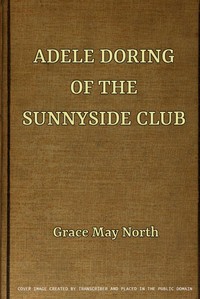
Adele Doring of the Sunnyside Club — Story, Setting & Ideas

(4 User reviews)   1121
North, Grace May, 1876-1960, Young, Florence Liley, 1872-1974 [Illustrator] Project Gutenberg 2020
Kindness -- Juvenile fiction; Girls -- Juvenile fiction; Girls -- Societies and clubs -- Juvenile fiction; Doring, Adele (Fictitious character) -- Juvenile fiction; Sunnyside Club (Imaginary organization) -- Juvenile fiction Readers of public-domain and historical texts
Project Gutenberg digital edition en

Edition facts

Words: 61,612
Reading time: 268 min
Text sections: 38
The opening chapters of Grace May North's 1919 novel show Adele Doring founding a club with friends, but the catalog subjects 'Kindness' and 'Girls -- Societies and clubs' only partially capture the book's early focus on springtime play, spontaneous verse, and a later embedded backwoods tale of a boy raised by a lumberjack with a pet bear.
Share
Editorial Edition Score 4.8/5

Calculated from edition completeness, EPUB availability, text structure and catalogue metadata. Not a user rating.

How this score is calculated
  • Description quality20 pts
  • Title & short description10 pts
  • Source metadata20 pts
  • Text length15 pts
  • Chapters / structure15 pts
  • EPUB file integrity20 pts

Total of 100 points, scaled to a 2.5-5.0 range. Editions with an empty description or a missing EPUB file are not scored.

Edition quality

Read the Text

was holding her little audience spellbound Eric and Everett soon had a crackling fire “The miser’s gold!”

ADELE DORING OF THE SUNNYSIDE CLUB

There was spring in the air, Though the woods were still bare. There was fragrance all about, Though not a flower was out. There were seven girls so gay Off for a holiday.

Across the April meadows they danced, a long row, hand in hand. Another month and the brown fields would be gold-and-white with daisies and buttercups.

“Look! Look! The pussy-willows are out!” Adele Doring called, as, with a shout of glee, she darted ahead of the rest, toward a bush which grew close to a low stone wall and not far from a sparkling brook.

When the others came up, they caught hold of hands and danced about the bush while Adele sang:

“‘Little Pussy-willow, harbinger of spring, We are glad to welcome you, such good news you bring.’”

“Adele,” drawled Rosamond Wright when they had paused for breath, “I’m powerful worried about you, for fear you are going to grow up to be a poet or something queer like that.”

Adele laughed as she perched on the low stone wall and fanned herself with her broad-brimmed hat.

“No fear of _my_ being a poet!” exclaimed Doris Drexel, as she and the other girls sat down on the warm brown grass. “Why I couldn’t even make ‘curl’ rhyme with ‘girl’ without being prompted.”

Then Adele, having put her hand in the pocket of her rose-colored sweater-coat, gave a sudden exclamation as she drew out a piece of folded paper.

“Girls!” she cried. “Lend me your ears! I have a secret plan to reveal.”

“Aha!” quoth Bertha Angel. “So you had a sinister motive, as Bob says, for bringing us to this lonely, forsaken spot.”

“You were wise to do so, if it’s a secret,” Rosie declared, “for even the walls have ears.”

“Well, if this old stone wall wants to hear what I have to say,” laughed Adele, “it may listen and welcome.”

“Do hurry and tell us!” cried the impatient Betty Burd. “Your plans are always _such_ jolly fun.”

“Well, then,” said Adele, mysteriously, “I’ve been reading a book.”

“But there is nothing remarkable about that,” Doris Drexel exclaimed. “You are almost _always_ reading a book.”

Adele, not heeding the interruption, continued: “And in this book dwell several maidens of about our own age. They belong to a secret society and they have the best times ever. Now my plan is this. Since we seven girls are continually together, suppose we have a club.”

“Wouldn’t that be fun, though!” exclaimed Peggy Pierce. “I’ve always wanted to belong to one.”

“I choose to be treasurer!” declared Betty Burd mischievously.

“Oh, Betty, _you_ treasurer!” cried Doris Drexel in mock horror. “Then we never would know how our funds stood.”

“Don’t you have enough of mathematics in school, little one?” Adele asked with twinkling eyes.

“Don’t I, though! Oh, girls!” Betty exclaimed dismally. “I just know that you are all thinking of yesterday. Wasn’t it terrible when I was at the board doing that problem and those visiting ladies came in and said that they were interested in watching the progress made by the young. I was so scared that every figure looked like a Chinese character to me, and how I did wish that a trap-door would open under my feet and let me gently down into the cellar. Luckily, Miss Donovan had no desire to be disgraced, and so she bade me take my seat and let Bertha do the problem.”

“I hate math., too,” Doris Drexel declared. “I’m like the little boy who said he could add the naughts all right but the figures bothered him.”

“In truth,” said Gertrude Willis, “there is just one of us who was born to be the treasurer of this club, and that one is Bertha Angel,—‘the only pupil in Seven B who can add and subtract with unvarying accuracy,’ as Miss Donovan so recently remarked.”

“Good!” cried Adele. “Bertha Angel, you are elected treasurer, but your duties will not be heavy, for at present there is no money to count.”

“I accept the responsibility,” said Bertha brightly, as she sprang up and made a bow.

“Now,” Adele inquired, “who would like to be secretary?”

“Secretary!” repeated Betty Burd blankly. “I thought that was a piece of furniture. My Uncle George has one in his study and it looks like a writing-desk.”

“So it is, fair maid,” drawled Rosamond Wright, “but didst thou never hear of one word having two meanings? The secretary which we want is a person to write down the clever things that we say and do.”

“I vote for Gertrude Willis,” called Doris Drexel. “Any one who could write such a composition as she read yesterday in assembly on the ‘Rights of the Indian’ surely ought to be recognized as a genius in our midst.”

“Thanks kindly,” laughed Gertrude; “I’ll do my little best.”

“Girls,” exclaimed Adele, “our club is now the happy possessor of a secretary and a treasurer, but it has neither a name nor a president!”

Peggy Pierce was on her feet in an instant, exclaiming, “There is only one among us who could be our president, and she is”—“Adele Doring!” the five others shouted in enthusiastic chorus.

“You see,” laughed Peggy, as she resumed her seat, “the vote is unanimous.”

Adele, rising, made a deep bow as she recited with mock gravity, “Ladies and gentlemen, I thank you for the honor which this day you have conferred upon me, and I hope that my future acts and deeds will in no way betray the confidence which you have placed in me.”

“Oho!” Bertha Angel declared. “That speech was in last week’s history lesson.”

“I was hoping you’d all forgotten it,” Adele laughingly replied, as she sat again on the low stone wall.

“Well, I had, you may be sure!” Betty Burd exclaimed. “But what is the club to be named?”

“I had an inspiration last night,” said Adele, “so I wrote it down. I thought we might name the club after our beautiful suburban town of Sunnyside, and then I wrote this rhyme as a sort of pledge for us all to sign:

“We promise to look on the Sunnyside And be kind and cheerful each day; To help the needy or lonely or sad, Whom we happen to meet on our way.”

“Oh, Adele!” moaned Betty Burd in pretended dismay. “Why didn’t you tell us in the beginning that we had to be saints to belong to your club? If I should turn into a cherub too suddenly, my mamma dear wouldn’t know me.”

“Don’t worry about that,” laughed Adele. “We aren’t any of us in danger of sprouting wings just at present.” And then she added seriously, “But I do think that a club ought to stand for something more worth while than just fun and frolic. Of course we’ll have that, too; we always do.”

“You are right, Adele,” exclaimed Gertrude Willis warmly. “I think it is a beautiful pledge, and I wish to be the first one to sign it.”

Adele produced a stub of a pencil, and the paper went the rounds, each girl writing her name thereon.

“Now,” said Adele, “only one thing remains to be decided upon, and that is, where we shall have our Secret Sanctum.”

“Our which?” asked the irrepressible Betty Burd.

“A place where we may hold our secret meetings,” Adele explained.

“You may use our attic if you wish,” drawled Rosamond, “but, I warn you, it’s powerful warm up there in the summer, and cobwebby.”

“An attic is all right on rainy days,” Adele replied, “but the blue sky is the roof for me, now that spring is here.”

While she was talking, Adele’s eyes were roving the meadow. Suddenly she saw something, and, leaping to the ground, she skipped about with delight, to the amazement of the others.

“Adele,” protested Peggy Pierce, “tell us, so we may dance, too.”

“Ohee!” sang out Adele, catching hold of Peggy and whirling her around. “I’ve just thought of the dan-di-est place for a Secret Sanctum, but I’m not going to tell until I find out if we may have it. Meet me Monday morning under the elm-tree and then I will tell you.”

So ended the first meeting of the Sunnyside Club, which was destined, in the months to come, to bring cheer and happiness into many lives.

The town of Sunnyside lay in a wide valley, beyond which were sloping hills, and among them, clear and blue, nestled Little Bear Lake.

To the south of the village there was a field which was so yellow in summer that it had been called Buttercup Meadows. Near it was a maple wood, and through the wood and across the field rippled a merry little brook.

Now, in the meadow and near the wood, and close to the laughing brook, stood a picturesque old log cabin. Years before, when the nearest town had been ten miles away, Adele Doring’s grandfather had owned all of the land that one could see from the top of Lookout Hill, and in this log cabin his sheep-herders had lived.

The sheep and the herders had long since passed away, but the old log cabin was still standing, and Adele’s father now owned it, and, too, he owned the Buttercup Meadows and the maple wood and the laughing brook and Lookout Hill.

It was that log cabin which Adele had seen on the day when the Sunnyside Club had been formed by the seven girls who were always together. They had been wondering where they could hold their meetings, when Adele had spied the log cabin, and she had thought at once that it would make an ideal Secret Sanctum, but she did not want to tell the others until she had asked her Giant Father’s advice and consent.

The next morning, after breakfast, Adele revealed her plan. “May you have the log cabin, Heart’s Desire?” her Giant Father asked with twinkling eyes. “Why, of course you may! Uncover yonder ink bottle and I will deed it to you this very moment.”

“Oh, Daddy!” Adele laughingly exclaimed. “I don’t want to own it that way. I just want your permission and mother’s to do with it as I like.”

Mrs. Doring beamed on them both as she replied, “If your father is willing, daughter, then so am I.”

“Oh, you darlings!” Adele exclaimed, joyously hugging them. “Thank you so much.” Then catching up her hat and books, away she skipped to school.

The trysting-place was a big spreading elm-tree which stood in the middle of the girls’ side of the school-yard. Under it was a circular bench, and here the seven maidens waited each morning until all had gathered.

When Adele rounded the high hedge which bordered the school-grounds, she was greeted with a joyous chorus from the six who were already there.

“Three cheers for the president of the Sunnyside Club!” cried Betty Burd, the irrepressible.

“Hush! Hush!” laughed Adele, looking quickly about. “Don’t you remember that it is a secret society?”

“Luckily there is no one here but ourselves and the elm-tree,” Rosamond said.

“Adele!” Gertrude Willis exclaimed. “Why are your eyes so shining and bright? Have you good news to tell?”

“Indeed I have,” Adele replied gayly. “Just think, girls, we may have it!”

“Have what?” asked the puzzled six.

“O dear, how stupid of me!” laughed Adele. “Of course I hadn’t told you about it, had I? Well, you know that we wanted a place in which to hold our club-meetings, and I said I had thought of one if we might have it.” The six nodded eagerly.

“Well, then, we may, and it’s the loveliest, idealest place for a Secret Sanctum that ever could be thought of.”

“Oh, Adele, do tell us where it is,” begged Peggy Pierce. “I am ’most consumed with curiosity.”

“Well, then, I will end your suspense by telling you that it is the log cabin over in Buttercup Meadows. It belongs to my dad, and he is glad to let us have it, and so is mumsie.”

“Ohee!” squealed Betty Burd. “How I do wish that there was no school to-day, so that we might go right over to look at our newest possession.”

“Let’s go at three!” exclaimed Adele; “that is, if our nice mothers do not need us after school.”

The mothers not only did not need them, but one and all were glad to have their daughters out of doors as much as possible in the pleasant spring weather, and so, as soon as the afternoon session was over, the seven maidens went hippety-skipping across the brown meadows.

Adele was armed with a good-sized key, which was rusty with age, but which proved that its days of usefulness were not over, for, when it was slipped in the padlock, it turned with a creak and the door swung open.

As first it was so dark within that they could see nothing, but soon their eyes, becoming accustomed to the dimness, noted several objects about.

“Oh, do look!” cried Doris Drexel in delight. “Here is rustic furniture which must have been made by the sheep-herders many years ago.”

“Can’t we get some light on the subject and a little air as well?” exclaimed Bertha Angel. “It’s stifling in here. Good! Here’s a window,” she added as she pulled a leather thong from a nail and threw back a rude wooden blind, thus uncovering a square opening, and through it came, not only a fresh breeze, but also the slanting rays of the afternoon sun.

“There! Now we can breathe,” said Adele, “and examine our possessions more closely.”

There was a rude bed-couch, a rustic table, and several three-legged stools. These were fashioned out of the trunks of small trees, with the bark still on them.

“Oh, but this will make an adorable Secret Sanctum,” exclaimed Betty Burd.

“Girls,” drawled the romantic Rosamond Wright, “if only this furniture could talk, what tales of sheep-herder’s life it could reveal!”

“The place is so musty and cobwebby,” said the practical Bertha, “we shall have to scrub every inch with warm soap-suds.”

“Oh, Burdie, how could you throw soapy water on my poetical dreams!” moaned Rosamond, who did not even like to hear a scrubbing-brush mentioned, much less entertain the idea of wielding one.

“Tut! Tut! My children!” Adele intervened. “Now all listen to me. You know the spring examinations are due in a few weeks, and we must study, study, _study_, and cram, cram, _cram_, so let’s forget that the cabin exists until next Saturday, and then let’s come out here with all the needed utensils, and, with Bertha to superintend the task, we will soon have the place as clean as a whistle.”

“Oh-h!” moaned Rosamond, and then she added mischievously, “I do believe that I’m going to be confined to my bed all day next Saturday with overstudyitis.”

“Don’t worry about that,” laughed Doris Drexel. “You may have overtattingitis, Rosie, but never overstudyitis.”

Rosamond had made yards and yards of tatting, which she said would some day adorn her wedding finery, and the other six often teased her about it, for, as yet, to them boys were playmates and brothers and nothing else.

Then Rosamond dramatically exclaimed: “Girls, I will not fail you in the hour of need. Armed with my mother’s best feather-duster, to be used on pianos only, I will be here Saturday next at the appointed hour.”

“Well, I’ll bring an extra scrubbing-brush, Rosie,” said Bertha teasingly.

“And let’s bring our lunches and stay all day if our nice mothers are willing,” Peggy Pierce remarked.

“That we will!” exclaimed the six. The door was again closed and the key hidden under a log which served as a step. Then, hand in hand, the Sunny Seven, as Adele called them, hippety-skipped homeward, chattering like magpies and laying wonderful plans for the adornment of their Secret Sanctum, which, in the summer to come, was to be the scene of many a jolly lark.

A JOLLY SCRUBBING-PARTY

The sky is always bluer, And the songs of birds more gay, And the meadow blossoms sweeter, Upon a Saturday. A week of lessons over, And long golden hours for play.

Saturday dawned sunny and blue, and Adele was up at an early hour and down in the kitchen before Kate had set the water to boil.

“The top of the morning to you!” Adele called to the kindly Irish woman who had been cook in the Doring family since before Jack was born.

“And it’s you, Colleen,” said Kate, “and some merriness you’re planning, to be up this early.”

“Right you are!” the girl gayly replied. “I’m going to a picnic, and I want to borrow a mop and a scrubbing-brush and a pail and some rags.”

Kate held up her hands in pretended horror as she exclaimed, “And a picnic do you call it?”

“It truly is,” laughed Adele, “and I want some sandwiches and pickles and some of those darling little cakes which you made yesterday morning, and—”

“Take anything that you can find, Colleen,” said Kate, as she busied herself with breakfast preparations.

So Adele put up a bountiful lunch in a covered basket which she kept for the purpose. Jack, who was a year older than Adele, sauntered out into the kitchen and helped himself to one of the chocolate cupcakes as he exclaimed: “Say, Della, why don’t you ever ask us fellows to these picnics of yours? It isn’t fair for you girls to eat all the good things by yourselves.”

“Maybe we will some day,” Adele replied. And then she added merrily, “But you wouldn’t want to be asked to-day.”

“I should say not,” Kate began, “with brooms and mops and pails—” But she said no more, for Adele, springing up, whispered, “Hush, Kate! It’s a secret!”

After breakfast Adele ran down to the barn, and Terrence, Mr. Doring’s handyman, hitched her black pony, Firefly, to the little red cart. Into this were stowed the lunch and cleaning utensils, and then Adele drove out of the yard, waving to her mother and Kate.

The homes of the other six were soon visited, as they were all in the same neighborhood, and each girl appeared with scrubbing-brush and apron and pail.

“We’ll take turns riding,” said Adele, as she leaped lightly to the ground. “Betty, you may drive, and Gertrude Willis, you climb in and ride and keep an eye on the scrubbing-brushes, lest they attempt to hop out over the sides. The rest of us will trudge along behind.”

Gertrude had not been strong during the winter, and that was why thoughtful Adele had suggested that she should ride; and as for little Betty Burd, the youngest of the seven, to own a pony like Firefly was the dearest desire of her heart, but her widowed mother felt that other luxuries were more necessary. Adele, knowing this, took every opportunity which offered to give Betty the pleasure of riding or driving Firefly.

Across the meadow they went, a gay cavalcade. Like all young things in spring, their hearts were filled with joy and they wanted to dance and sing. During the week the maple wood had changed from brown to silvery green, and there were patches of fresh grass along the banks of the laughing brook.

“Hark!” cried Adele with glowing eyes, as she stopped and held up one hand. “Did I hear it or did I not?”

They all listened, and from a clump of bushes near there arose, sweet and clear, the morning song of a robin. Then, with a rushing of wings, the redbreast was up and away.

“Cheerily! Cheerily! The robins sing. We’ve come to tell you. It’s spring! It’s spring!”

“I hope you all wished on the first robin,” Rosamond exclaimed, “for that wish is sure to come true.”

“Well,” said Adele thoughtfully, “I don’t believe that there’s a thing in the whole world that I have to wish for. I’ve mother and father and Jack and a happy home and such nice friends. What is there left for one to desire?”

The first chapter of Adele Doring of the Sunnyside Club opens with seven girls dancing across April meadows, hand in hand, and Adele spontaneously composing a couplet about pussy-willows. The catalog subjects list 'Girls -- Societies and clubs' and 'Kindness,' but the excerpt shows the club being proposed almost as an afterthought—Rosamond Wright’s drawled worry that Adele might 'grow up to be a poet' gets more immediate attention than any organizational plan. The narrative voice is brisk and playful, with dialogue that often undercuts sentiment: when Adele sings her little verse, a friend responds with mock concern rather than praise.

A Club Proposed, Not Yet Defined

The catalog subject 'Girls -- Societies and clubs' suggests a story centered on club activities, but the excerpt from Chapter One shows the club itself is barely sketched. The girls are more occupied with the sensory details of spring—pussy-willows, a sparkling brook, a low stone wall—than with rules or purposes. Adele’s exclamation 'Suppose we have a club' appears as the book’s frontispiece caption, yet in the text it is a brief suggestion amid dancing and singing. The club’s name, Sunnyside, is not explained in the opening pages; the focus remains on the group’s easy camaraderie and the natural setting. This gap between catalog expectation and textual evidence suggests that the club may develop later, but the early chapters prioritize atmosphere and character interaction over institutional detail.

Embedded Storytelling: The Lumber-Camp Tale

Later in the excerpts, the narrative shifts abruptly into a long embedded story told by a character named Jock Henderson. This tale—about a boy called 'the Kid' raised in a lumber camp with a pet bear named Little Bear—occupies several pages and includes a fiddle-playing mentor, a lost letter, and a wealthy uncle’s arrival. The catalog subject 'Kindness' might apply to Jock’s care for the orphaned boy, but the excerpt emphasizes the rough setting, the bear’s tricks, and the emotional tension of the uncle’s appearance. The voice changes markedly: Jock speaks in dialect ('powerful proud,' 'shy-like'), and the prose becomes more dramatic. This section is a story within the story, and its length and detail suggest that the novel may interweave multiple narrative threads, not all directly tied to the Sunnyside Club.

Illustrations and Their Captions

The excerpts include four illustration captions: 'Suppose we have a club,' 'Adele was holding her little audience spellbound,' 'Eric and Everett soon had a crackling fire,' and 'The miser’s gold!' These captions hint at plot elements—a campfire scene, a treasure motif—that do not appear in the provided text excerpts. The first caption matches the club’s founding moment, but the others suggest adventures (a fire, a miser’s gold) that may involve boys (Eric and Everett) and a mystery. The catalog subjects do not mention boys, treasure, or fireside scenes, indicating that the book’s scope extends beyond the girls’ club into broader adventure territory. Readers should expect the illustrations to foreshadow episodes not yet encountered in the opening chapters.

Because the excerpts cover only the first chapter and a later embedded tale, the full structure of Adele Doring of the Sunnyside Club remains unclear. The club may become more central as the story progresses, or it may serve as a framing device for a series of adventures. Readers should note the shift in tone between the light, poetic opening and the dialect-heavy lumber-camp story. Pay attention to how the narrative handles transitions between the girls’ world and the boy’s backstory—this may reveal the novel’s method of weaving together different characters and settings.

I keep thinking about springtime in the Sunnyside Club’s opening, that unhurried play before any rules existed, and it drifts me to a dusty canyon where another kind of wildness waits. The warmth of simple company feels the same, somehow. That’s why I pulled up The X Bar X boys in Thunder Canyon — Story, Setting & Ideas again, just to sit with the feeling a little longer.

Evelyn Martinez
1 week ago

Camila Torres
2 weeks ago

Anthony Moore
1 week ago

Camila Wright
2 weeks ago

5
5 out of 5 (4 User reviews )

Add a Review

Your Rating *
  • ...
    Carla Chambers - 3 weeks ago
    {'positive': "A delightful story about friendship, school life, and growing up. Adele Doring is a charming, relatable protagonist, and her adventures with the Sunnyside Club are heartwarming. The book captures the spirit of friendship and the small dramas of teenage life with warmth and humor. It's a gentle, uplifting read that reminds us of the joys of simple times. I adored every moment and highly recommend it to anyone looking for a cozy, feel-good story.", 'neutral': "The character dynamics are sweet and the settings are picturesque, but the plot is thin with little dramatic tension. It's more of a slice-of-life than an adventure, which might not satisfy thrill-seekers. Still, it's a pleasant read for lovers of old-fashioned girls' stories.", 'negative': 'For modern readers, this book is painfully dated, with clichéd characters and a plot that goes nowhere. The issues the girls face are trivial, and the writing is overly descriptive without purpose. The lack of conflict makes it a tedious read. Unless you have a strong interest in early 20th-century juvenile fiction, give this a pass.'}


Reader reflection

How did this book work for you?

Your answers remain private and are stored only in this browser.

Your progress 0 / 10
1

Where are you in your reading?

2

Did this book hold your interest?

3

Would you encourage someone else to read it?

4

How easy was the book to follow?

Related eBooks