1

The X Bar X boys in Thunder Canyon — Story, Setting & Ideas
(0 User reviews)
540
Project Gutenberg
2023
Not confirmed
Western stories; Kidnapping -- Juvenile fiction; Ranch life -- Juvenile fiction; West (U.S.) -- Juvenile fiction; Cowboys -- Juvenile fiction
Readers of public-domain and historical texts
Project Gutenberg digital edition
en
Edition facts
Words
50,355
Reading time
219 min
Text sections
7
For The X Bar X boys in Thunder Canyon — Story, Setting & Ideas, the stored edition analysis reports 50,355 words, 3 hr 39 min estimated reading time, and 7 detected text sections.
The text analysis averages about 11.9 words per sentence, while the detected sections provide another way to judge how the source is divided.
Project Gutenberg metadata also associates the work with “Western stories,” connecting these edition facts with the source record’s subject description.
Source:
Project Gutenberg record #71964
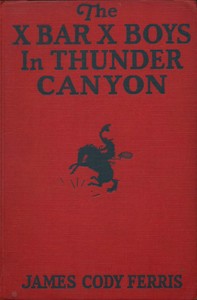
This editorial note examines the structure and recurring imagery in James Cody Ferris's 1926 Western adventure, focusing on how the narrative moves between ranch life and pursuit, with particular attention to the porcupine encounter, the threat note, and the kidnapping scene.
Read the complete public-domain text at its original source.
Read on Project GutenbergThe X Bar X Boys in Thunder Canyon opens with a porcupine blocking the trail, a small obstacle that prompts the brothers Roy and Teddy to debate frontier folklore. This early exchange establishes a pattern: the narrative often pauses for natural details—a horse's gesture, a quilled animal—before accelerating into action. The story moves between the everyday rhythms of ranch life and sudden crises, a structure that keeps the reader alert to shifts in tone.
Pauses and Precipices
The first chapter's porcupine scene is more than local color. Roy dismisses Pop Burns's claim that porcupines shoot quills, but the animal's presence introduces a motif of hidden dangers. The brothers' horses react with specific personalities: Flash walks stiff-legged, Star allows ear-touching only from Roy. These small behavioral details ground the story in observed ranch life. Later, when the kidnapping is revealed, the narrative again pauses—this time on a garden rose and a creaking screen door—before the chase begins. The structure relies on such quiet moments to heighten the impact of violence or threat.
The Threatening Note as Narrative Engine
Twice in the excerpts, a written message drives the plot. First, a note tied to a stick is flung at the bunkhouse, warning Roy and Teddy's father against pressing charges. Second, a note confirms the girls have been taken. Both are delivered by a mysterious rider, and both are written in the same hand—that of “Reltsur,” a name Teddy deciphers backward. The repetition of this device gives the story a puzzle-like quality: the boys must read between lines and reverse names. The notes also link the rustler subplot to the kidnapping, suggesting a single antagonist orchestrating multiple threats.
Mrs. Ball's Refusal to Be Sidelined
When the girls vanish, Mrs. Ball demands a gun and insists on joining the rescue. Her husband gently overrules her, citing her heart condition and the need for someone to stay behind. Yet her speech—declaring she has not forgotten how to shoot—is the emotional peak of the excerpt. The scene balances her fierce will against the practical constraints of the genre, where women often remain at home. Her final command to Pete, “bring back those girls,” carries the weight of twenty-six years of partnership. The narrative does not dismiss her; it gives her a resonant voice before the men ride out.
Movement Between Interior and Exterior
The story alternates between open range and enclosed spaces. The brothers ride through canyons and trails, but key revelations occur indoors: the Ball family living room, where the note is read, and the bunkhouse, where the first warning arrives. Sensory details mark these transitions. Outdoors, the focus is on horses and landscape; indoors, it shifts to objects—a rose, a creaking door, a paper. This oscillation creates a rhythm of exposure and shelter. The kidnapping itself violates the safety of the home, turning the interior into a site of loss. The chase that follows will return the characters to the open, where the canyon of the title awaits.
Readers will find that the book's effectiveness depends less on plot twists than on the careful placement of small, telling details. Pay attention to how the brothers read the landscape and the people they meet; the story rewards those who notice the porcupine before the landslide.
There’s something about the quiet threat in that porcupine scene — how stillness carries its own warning — that stuck with me long after closing The X Bar X Boys. It felt less like adventure and more like waiting, that same held breath I remember finding in Greycliff Wings — Reading Notes. Strange how two different skies recall the same hush.
There are no reviews for this eBook.
There are no comments for this eBook.
Reader reflection
Before you leave, reflect on the book
Use these questions to collect your thoughts before moving on.
Your progress
0
/
10
2
Did this book hold your interest?
3
Would you encourage someone else to read it?
4
How much effort did this book require?
5
Was the book what you thought it would be?
6
Which element worked best for you?
7
Could you follow the author’s main argument?
8
Did you relate to its people, ideas, or situations?
9
What is the main idea you are taking away?
10