1

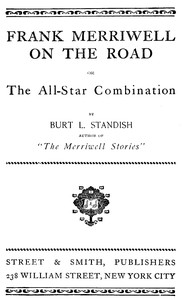
Frank Merriwell on the Road; Or, The All-Star Combination — Key Ideas to Explore
(0 User reviews)
386
Project Gutenberg
2020
Not confirmed
Young men -- Conduct of life -- Juvenile fiction; Adventure stories; Dime novels; Mystery fiction; Jealousy -- Juvenile fiction; Merriwell, Frank (Fictitious character) -- Juvenile fiction; Actors -- Juvenile fiction; Attempted murder -- Juvenile fiction; Traveling theater -- Juvenile fiction; Morphine abuse -- Juvenile fiction
Readers of public-domain and historical texts
Project Gutenberg digital edition
en
Edition facts
Words
55,072
Reading time
240 min
Text sections
28
For Frank Merriwell on the Road; Or, The All-Star Combination — Key Ideas to Explore, the stored edition analysis reports 55,072 words, 4 hr estimated reading time, and 28 detected text sections.
The text analysis averages about 12.2 words per sentence, while the detected sections provide another way to judge how the source is divided.
Project Gutenberg metadata also associates the work with “Young men -- Conduct of life -- Juvenile fiction,” connecting these edition facts with the source record’s subject description.
Source:
Project Gutenberg record #63815
This editorial note examines the narrative voice and pacing in Burt L. Standish's Frank Merriwell on the Road, focusing on the fight scene in Chapter XVI to show how dialogue, action, and comic relief shape the story's rhythm.
Read the complete public-domain text at its original source.
Read on Project GutenbergIn Chapter XVI of Frank Merriwell on the Road, the narrative voice shifts abruptly from measured exposition to rapid-fire action. The fight scene between Frank and Dunton is a concentrated example of how Standish uses short, punchy sentences and staccato dialogue to accelerate pace. Frank's calm, ironic remarks—"Glad you gentlemen called"—contrast with the physical violence, creating a comic tension that defines the book's tone. The scene also relies on a repeated structural pattern: Frank dispatches one opponent, then the next, with the same efficient moves, reinforcing his competence through rhythm rather than description.
Dialogue as a Pacing Tool
Standish frequently breaks action with dialogue that serves both to characterize and to control tempo. In the fight, Frank's lines are terse and understated: "I don't think!" and "Would you!" These interjections slow the narrative just enough to let the reader register the violence without losing momentum. By contrast, Dunton's threats are melodramatic—"I'll kill you!"—and his friend Sargent's protests are whining: "I didn't come up to fight with you!" The contrast in speech patterns underscores the moral hierarchy: Frank's coolness versus his opponents' bluster. The dialogue also provides comic relief, as when Frank tells Havener, "Got one under the bed, and the other is—going." This interplay of action and talk is a hallmark of the Merriwell series, where verbal sparring is as important as physical combat.
Physical Description and Comic Repetition
The fight scene relies on a limited set of physical actions—throwing, slamming, shoving—repeated with variations. Frank "flung" Dunton across the bed, then "slammed" Sargent against the door, then "fired" him under the bed. The repetition of similar verbs creates a rhythmic, almost mechanical quality, emphasizing Frank's control. The image of two pairs of feet sticking out from under the bed is a visual gag that recurs in the series: a defeated opponent literally hidden from view. Standish uses this comic tableau to defuse tension, and the laughter of Ephraim Gallup and Havener signals to the reader that the fight is not a serious threat but a demonstration of Frank's superiority. The description of Dunton "literally frothed at the mouth" is an exaggerated detail typical of dime-novel style, heightening the melodrama while keeping the tone light.
Narrative Voice and the Role of the Stage Manager
The entrance of Havener, the stage-manager, shifts the narrative perspective. His question—"What's going on in there?"—prompts Frank to summarize the fight in a single line: "I am practicing a little." This meta-theatrical remark aligns the fight with performance, a theme reinforced by the setting (a traveling theater company). Havener's rare laugh—"a man who seldom smiled"—marks the scene as an exception to the usual seriousness. The narrative voice here is omniscient but selective, focusing on Frank's actions and the reactions of onlookers. The description of Dunton grinding his teeth and making a "murderous" look adds a hint of menace that the comic tone otherwise undercuts. This balance between threat and humor is characteristic of Standish's style, where violence is always contained by Frank's moral authority and the story's lighthearted frame.
Readers attentive to narrative rhythm will notice how Standish alternates between fast action and slower, dialogue-driven passages. The fight in Chapter XVI is a microcosm of the book's pacing: bursts of physical comedy followed by explanatory or humorous exchanges. Pay attention to how Frank's voice—calm, ironic, and in control—shapes the reader's expectations, even when the plot introduces darker elements like morphine abuse or attempted murder. The consistency of his tone is the book's central narrative device.
That fight in Frank Merriwell on the Road—the way the rhythm shifts between quick dialogue and sudden stillness—stayed with me long after I put it down. It reminded me of a quieter, weirder charm in The Haven Children; or, Frolics at the Funny Old House on Funny Street — Inside the Classic, where the laughter feels just as carefully timed. Both made me miss being lost in a book like that.
There are no reviews for this eBook.
There are no comments for this eBook.
Reader reflection
Before you leave, reflect on the book
Use these questions to collect your thoughts before moving on.
Your progress
0
/
10
2
How much did you enjoy the reading experience?
3
How likely are you to recommend this book?
4
How demanding did the text feel?
5
How personally connected did you feel to the book?
6
Did you gain anything practical from the text?
7
Do you expect to return to this book?
8
How did the reading compare with what you expected?
9
In one sentence, what did you learn?
10