1

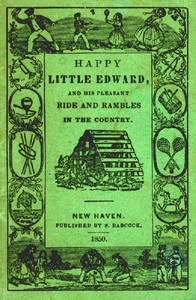
Happy Little Edward And His Pleasant Ride and Rambles in the Country. — Edition Insights
(0 User reviews)
388
Project Gutenberg
2004
Not confirmed
Children's stories; Boys -- Conduct of life -- Juvenile fiction; Country life -- Juvenile fiction; Cousins -- Juvenile fiction; Travel -- Juvenile fiction; Massachusetts -- Juvenile fiction
Readers of public-domain and historical texts
Project Gutenberg digital edition
en
Edition facts
Words
5,017
Reading time
22 min
Text sections
1
Happy Little Edward And His Pleasant Ride and Rambles in the Country. — Edition Insights can be approached with a clearer sense of reading commitment from its source measurements: 5,017 words, 22 min estimated reading time, and 1 detected text section.
The text analysis averages about 24.6 words per sentence, while the detected sections provide another way to judge how the source is divided.
Project Gutenberg metadata also associates the work with “Children's stories,” connecting these edition facts with the source record’s subject description.
Source:
Project Gutenberg record #10779
This editorial note examines the narrative voice and pacing in 'Happy Little Edward,' a mid-19th-century children's story. It highlights the shift from instructional dialogue to descriptive observation, the use of rhythmic verse, and the careful modulation of pace as Edward travels from city to country.
Read the complete public-domain text at its original source.
Read on Project GutenbergThe opening verse of Happy Little Edward immediately establishes a direct, coaxing address to child readers: “Come, little children, wake from sleep, / And into the country take a peep.” This rhythmic invitation sets a tone of gentle urgency, positioning Edward as a guide. The prose that follows, however, adopts a more measured, instructive voice. The narrator describes Edward as “good, and of course a happy little boy,” linking morality to contentment without elaboration. The early paragraphs move briskly through preparation and departure, but the pace slows markedly once the family stops by the river. Here, the narrative shifts from action to observation: Edward dips his fingers in the stream, notices a squirrel, and listens to a woodpecker. The mother’s explanations—about rivers flowing to the ocean, squirrel varieties, and the woodpecker’s feeding method—introduce a didactic layer that pauses the journey’s forward momentum.
Rhythmic Invitation and Moral Framing
The book’s opening poem functions as a compact narrative frame. Its trochaic meter and rhyming couplets (“Happy Edward leads the way, / So haste to the country, haste away!”) create a sing-song quality typical of mid-19th-century children’s literature. This verse voice contrasts with the prose narrator’s more sober tone. The prose quickly establishes Edward’s moral standing: he is “good, and of course a happy little boy.” The conjunction “of course” implies an unexamined equation between goodness and happiness, a premise the story does not challenge. The narrator does not dwell on Edward’s emotions; instead, actions convey his eagerness—he “could hardly wait” while being dressed. This economy of psychological description keeps the focus on external events, a pattern that persists throughout the excerpt.
Pacing Through Dialogue and Description
The journey’s pace is carefully modulated. Initially, the narrative moves quickly: the carriage arrives, Edward is dressed, and they depart. But at the riverside stop, the tempo decelerates. The mother’s dialogue becomes the primary vehicle for information. She explains the river’s destination, identifies the squirrel, and interprets the woodpecker’s sound. Edward’s questions—“What is that running up the tree, mother?”—are simple and observational, not introspective. The narrator’s descriptions grow more detailed: “the air was full of the sweet scent of the early flowers, and the grass was green and bright with the freshness of Spring.” This sensory richness contrasts with the earlier, sparser prose. After the stop, the pace quickens again as Edward’s thoughts shift from the squirrel and bird to anticipation of his cousins. The narrative thus alternates between rapid travel and reflective pauses, a rhythm that mirrors the physical journey.
Voice and the Child’s Perspective
The narrator maintains a consistent third-person voice that occasionally adopts Edward’s limited viewpoint. When Edward sees the woodpecker, the text notes it was “just as if it wanted some one to open the door!”—a simile that reflects a child’s imaginative interpretation. Similarly, the squirrel’s “bright quick eyes” and “bushy tail” are details a four-year-old might notice. Yet the narrator does not fully inhabit Edward’s consciousness; the mother’s explanations remain in adult language. The result is a dual perspective: the child’s wonder is described but not internalized. The verse prologue’s direct address to “little children” suggests the intended audience, but the prose often speaks over Edward’s head. This tension between engaging the child reader and instructing them is characteristic of the period’s didactic fiction.
Readers attentive to narrative rhythm will notice how the story’s pace mirrors Edward’s shifting attention—quick during travel, slow during discovery. The mother’s dialogues serve as both instruction and structural breaks. The verse frame invites participation, while the prose maintains a measured distance. This interplay of voices and tempos makes Happy Little Edward a compact example of mid-19th-century children’s storytelling, where moral certainty and natural observation coexist.
Reading about Edward’s gentle shift from city bustle to country quiet, I kept thinking of another kind of journey, one toward self-made speed. There’s a similar unhurried warmth in how Happy Little Edward savors each roadside detail, a patience that reminded me of the determined boy in Ben Hardy's flying machine; or, Making a record for himself — Edition Insights. Both feel like old, kind afternoon light.
There are no reviews for this eBook.
There are no comments for this eBook.
Reader reflection
Take a moment to reflect on this book
Create a short personal record of your experience with this book.
Your progress
0
/
10
2
Did this book hold your interest?
3
Would you recommend this book to another reader?
4
What was the reading difficulty like?
5
What was its emotional impact?
6
How useful were the ideas in this book?
7
Could you see yourself revisiting this book?
8
What did you think about the pace?
9
What did this book teach you most?
10