
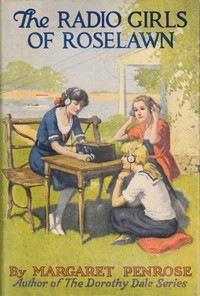
The radio girls of Roselawn — Text and Context
Edition facts
Calculated from edition completeness, EPUB availability, text structure and catalogue metadata. Not a user rating.
How this score is calculated
- Description quality20 pts
- Title & short description10 pts
- Source metadata20 pts
- Text length15 pts
- Chapters / structure15 pts
- EPUB file integrity20 pts
Total of 100 points, scaled to a 2.5-5.0 range. Editions with an empty description or a missing EPUB file are not scored.
Read the Text
ported killed in the Civil War, and he came home and pointed out several things they had got wrong in the newspaper obituary—especially the date of his demise. Now this——”
“I am going to get a book about it, and that will tell us just what to do in getting a radio set established.”
“I’ll tell you the first thing to do,” scoffed Amy. “Dig down into your pocketbook.”
“It won’t cost much. But I mean to have a good one.”
“All right, dear. I am with you. Never let it be said I deserted Poll. What is the first move?”
“Now, let me see,” murmured Jessie, staring off across the sunflecked lawn.
The Norwood estate was a grand place. The house, with its surrounding porches, stood in Roselawn upon a knoll with several acres of sloping sod surrounding it and a lovely little lake at the side. There was a long rose garden on either side of the house, and groups of summer roses in front. Roses, roses, roses, everywhere about the place! The Norwoods all loved them.
But there were more roses in this section of the pretty town of New Melford, and on that account many inhabitants of the place had gotten into the habit of calling the estates bordering the boulevard by the name of Roselawn. It was the Roselawn district, for every lawn was dotted with roses, red, pink, white, and yellow.
The Norwoods were three. Jessie, we put first because to us she is of the most importance, and her father and mother would agree. Being the only child, it is true they made much of her. But Jessie Norwood was too sweet to be easily spoiled.
Her father was a lawyer in New York, which was twenty miles from New Melford. The Norwoods had some wealth, which was good. They had culture, which was better. And they were a very loving and companionable trio, which was best.
Across the broad, shaded boulevard was a great, rambling, old house, with several broad chimneys. It had once been a better class farmstead. Mr. Wilbur Drew, who was likewise a lawyer, had rebuilt and added to and improved and otherwise transformed the farmhouse until it was an attractive and important-looking dwelling.
In it lived the lawyer and his wife, his daughter, Amy, and Darrington Drew, when he was home from college. This was another happy family—in a way. Yet they were just a little different from the Norwoods. But truly “nice people.”
When Amy Drew once gave her mind to a thing she could be earnest enough. The little her chum had read her from the magazine article began to interest her. Besides, whatever Jessie was engaged in must of necessity hold the attention of Amy.
She laid aside the knitting and went to sit beside Jessie in the swing. They turned back to the beginning of the article and read it through together, their arms wound about each other in immemorial schoolgirl fashion.
Of course, as Amy pointed out, they were not exactly schoolgirls now. They were out of school—since two days before. The long summer vacation was ahead of them. Time might hang idly on their hands. So it behooved them to find something absorbing to keep their attention keyed up to the proper pitch.
“Tell you what,” Amy suggested. “Let’s go down town to the bookstore and see if they have laid in a stock of this radio stuff. We want one or two of the books mentioned here, Jess. We are two awfully smart girls, I know; we will both admit it. But some things we have positively got to learn.”
“Silly,” crooned Jessie, patting her chum on the cheek. “Let’s go. We’ll walk. Wait till I run and see if Momsy doesn’t want something from down town.”
“We won’t ask Mrs. Drew that question, for she will be pretty sure to want a dozen things, and I refuse—positively—to be a dray horse. I ‘have drew’ more than my share from the stores already. Cyprian in the car can run the dear, forgetful lady’s errands.”
Jessie scarcely listened to this. She ran in and ran out again. She was smiling.
“Momsy says all she wants is two George Washington sundaes, to be brought home in two separate parcels, one blonde and one brunette,” and she held up half a dollar before Amy’s eyes.
“Your mother, as I have always said, Jess, is of the salt of the earth. And she is well sugared, too. Let me carry the half dollar, honey. You’ll swallow it, or lose it, or something. Aren’t to be trusted yet with money,” and Amy marched down the steps in the lead.
She always took the lead, and usually acted as though she were the moving spirit of the pair. But, really, Jessie Norwood was the more practical, and it was usually her initiative that started the chums on a new thing and always her “sticktoitiveness” that carried them through to the end.
Bonwit Boulevard, beautifully laid out, shaded with elms, with a grass path in the middle, two oiled drives, and with a bridle path on one side, was one of the finest highways in the state. At this hour of the afternoon, before the return rush of the auto-commuters from the city, the road was almost empty.
The chums chatted of many things as they went along. But Jessie came back each time to radio. She had been very much interested in the wonder of it and in the possibility of rigging the necessary aerials and setting up a receiving set at her own house.
“We can get the books to tell us how to do it, and we can buy the wire for the antenna to-day,” she said.
“‘Antenna’! Is it an insect?” demanded Amy. “Sounds crawly.”
“Those are the aerials——”
“Listen!” interrupted Amy Drew.
A sound—a shrill and compelling voice—reached their ears. Amy’s hand clutched at Jessie’s arm and held her back. There was nobody in sight, and the nearest house was some way back from the road.
“What is it?” murmured Jessie.
“Help! He-e-elp!” repeated the voice, shrilly.
“Radio!” muttered Amy, sepulchrally. “It is a voice out of the air.”
There positively was nobody in sight. But Jessie Norwood was practical. She knew there was a street branching off the boulevard just a little way ahead. Besides, she heard the throbbing of an automobile engine.
“Help!” shrieked the unknown once more.
“It is a girl,” declared Jessie, beginning to run and half dragging Amy Drew with her. “She is in trouble! We must help her!”
Like a great many other beautiful streets, there was a poverty-stricken section, if sparsely inhabited, just behind Bonwit Boulevard. A group of shacks and squatters’ huts down in a grassy hollow, with a little brook flowing through it to the lake, and woods beyond. It would not have been an unsightly spot if the marks of the habitation of poor and careless folk had been wiped away.
But at the moment Jesse Norwood and her chum, Amy Drew, darted around from the broad boulevard into the narrow lane that led down to this poor hamlet, neither of the girls remembered “Dogtown,” as the group of huts was locally called. The real estate men who exploited Roselawn and Bonwit Boulevard as the most aristocratic suburban section of New Melford, never spoke of Dogtown.
“What do you suppose is the matter, Jess?” panted Amy.
“It’s a girl in trouble! Look at that!”
The chums did not have to go even as far as the brow of the hill overlooking the group of houses before mentioned. The scene of the action of this drama was not a hundred yards off the boulevard.
A big touring car stood in the narrow lane, headed toward the broad highway from which Jessie and Amy had come. It was a fine car, and the engine was running. A very unpleasant looking, narrow-shouldered woman sat behind the steering wheel, but was twisted around in her seat so that she could look behind her.
In the lane was another woman. Both were expensively dressed, though not tastefully; and this second woman was as billowy and as generously proportioned as the one behind the wheel was lean. She was red-faced, too, and panted from her exertions.
Those exertions, it was evident at once to Jessie and Amy, were connected with the capturing and the subsequent restraining of a very active and athletic girl of about the age of the chums. She was quite as red-faced as the fleshy woman, and she was struggling with all her might to get away, while now and then she emitted a shout for help that would have brought a crowd in almost no time in any place more closely built up.
“Oh! What is the matter?” repeated Amy.
“Bring her along, Martha!” exclaimed the woman already in the motor-car. “Here come a couple of rubber-necks.”
This expression, to Jessie’s mind, marked the driver of the automobile for exactly what she was. Nor did the face of the fat woman impress the girl as being any more refined.
As for the girl struggling with the second woman—the one called “Martha”—she was not very well dressed. But she looked neat and clean, and she certainly was determined not to enter the automobile if she could help it. Jessie doubted, although she had at first thought it possible, if either of these women were related to the girl they seemed so determined to capture.
“What are they—road pirates? Kidnapers?” demanded Amy. “What?”
The two chums stopped by the machine. They really did not know what to do. Should they help the screaming girl? Or should they aid the fleshy woman? It might be that the girl had run away from perfectly good guardians. Only, to Jessie’s mind, there was something of the refinement that pertained to the girl lacking in the appearance of these two women. She was not favorably impressed by them.
“What is the matter with the girl?” she asked the woman in the car.
Although she said it politely, the woman flashed her a scowling glance and said:
“Mind your own business!”
“My!” gasped Amy at this, her eyes opening very wide.
Jessie was not at all reassured. She turned to the fleshy woman, and repeated her question:
“What is the matter with the girl?”
“She’s crazy, that’s what she is!” cried the woman. “She doesn’t know what is good for her.”
“I’ll learn her!” rasped out the driver of the car.
“Don’t!” shouted the girl. “Don’t let them take me back there——”
Just then the fleshy woman got behind her. She clutched the girl’s shoulders and drove her harshly toward the car with her whole weight behind the writhing girl. The other woman jumped out of the car, seized the girl by one arm, and together the women fairly threw their captive into the tonneau of the car, where she fell on her hands and knees.
“There, spiteful!” gasped the lean woman. “I’ll show you!”
She hopped back behind the steering wheel. The fleshly woman climbed into the tonneau and held the still shrieking girl. The car started with a dash, the door of the tonneau flapping.
“Oh! This isn’t right!” gasped Jessie.
“They are running away with her, Jess,” murmured Amy. “Isn’t it exciting?”
“It’s mean!” declared her chum with conviction. “How dare they?”
“Why, to look at her, I think that skinny woman would dare anything,” remarked Amy. “And—haven’t—you seen her before?”
“Never! She doesn’t live around here. And that car is strange.”
The car had turned into the boulevard and headed out of town. When the girls walked back to the broad highway it was out of sight. It was being driven with small regard for the speed laws.
“I guess you are right,” reflected Amy. “I never saw that car before. It is a French car. But the woman’s face——”
“There was enough of that to remember,” declared Jessie, quite spitefully.
“I didn’t mean the fat woman’s face,” giggled Amy. “I mean that the other woman looked familiar. Maybe I have seen her picture somewhere.”
“If my face was like hers I’d never have it photographed,” snapped Jessie.
“How vinegarish,” said Amy. “Well, it was funny.”
“You do find humor in the strangest things,” returned her chum. “I guess that poor girl didn’t think it was funny.”
“Of course, they had some right to her,” Amy declared.
“How do you know they did? They did not act so,” returned the more thoughtful Jessie. “If they had really the right to make the poor girl go with them, they would not have acted in such haste nor answered me the way they did.”
“Well, of course, it wasn’t any of our business either to ask questions or to interfere,” Amy declared.
“I don’t know about that, Amy,” rejoined her chum. “I wish your brother had been here, or somebody.”
“Darry!” scoffed Amy.
“Or maybe Burd Alling,” and Jessie’s eyes twinkled.
“Well,” considered Amy demurely, “I suppose the boys might have known better what to do.”
“Oh,” said Jessie, promptly, “I knew what to do, all right; only I couldn’t do it.”
“Stopped the women and made them explain before we allowed them to take the girl away. And I wonder where she was going. When and where did she run away from the women? Did you hear her beg us not to let them take her back—back——”
“That is it, exactly,” sighed Jessie, as the two walked on toward town. “She did not tell us where.”
“Some institution, maybe. An orphan asylum,” suggested Amy.
“Did you think she looked like an orphan?”
“How does an orphan look?” giggled Amy. “I don’t know any except the _Molly Mickford_ kind in the movies, and they are always too appealing for words!”
“Somehow, she didn’t look like that,” admitted Jessie.
“She fought hard. I believe I would have scratched that fat woman’s face myself, if I’d been her. Anyway, she wasn’t in any uniform. Don’t they always put orphans in blue denim?”
“Not always. And that girl would have looked awful in blue. She was too dark. She wasn’t very well dressed, but her clothes and their colors were tasteful.”
“Aren’t you the observing thing,” agreed Amy. “She was dressed nicely. And those women were never guards from an institution.”
“It was a private kidnaping party, I guess,” said Amy.
“And we let it go on right under our noses and did not stop it,” sighed Jessie Norwood. “I’m going to tell my father about it.”
Amy grinned elfishly. “He will tell you that you had a right, under the law, to stop those women and make them explain.”
“Ye-es. I suppose so. But a right to do a thing and the ability to do it, he will likewise tell me, are two very different things.”
“Wisdom from the young owl!” laughed Amy. “Well, I don’t suppose, after all, it is any of our business, or ever will be. The poor thing is now a captive and being borne away to the dungeon-keep. Whatever that is,” she added, shrugging her shoulders.
INTEREST IN RADIO SPREADS
Over the George Washington sundaes at the New Melford Dainties Shop the girls discussed the mysterious happening on Dogtown Lane until it was, as Amy said, positively frayed.
“We do not know what it was all about, my dear, so why worry our minds? We shall probably never see that girl again, or those two women. Only, that lean one—well! I know I have seen her somewhere, or somebody who looks like her.”
“I don’t see but you are just as bad as I am,” Jessie Norwood said. “But we did not come to town because of that puzzling thing.”
“No-o. We came to get these perfectly gorgeous sundaes,” declared Amy Drew. “Your mother, Jess, is almost as nice as you are.”
“We came in to get radio books and buy wire and stops and all that for the aerials, anyway. Of course, I shall have to send for most of the parts of the house set. There is no regular radio equipment dealer in New Melford.”
“Oh, yes! Wireless!” murmured Amy. “I had almost forgotten that.”
They trotted across the street to the bookstore. Motors were coming up from the station now, and from New York. They waved their hands to several motoring acquaintances, and just outside Ye Craftsman’s Bookshop they ran into Nell Stanley, who they knew had no business at all there on Main Street at this hour of the afternoon. Nell was the minister’s daughter, and there were a number of little motherless Stanleys at the parsonage (Amy said “a whole raft of them”) who usually needed the older sister’s attention, approaching supper time.
“Oh, I’ve a holiday,” laughed Nell, who was big and strong and really handsome, Jessie thought, her coloring was so fresh, her chestnut hair so abundant, her gray eyes so brilliantly intelligent, and her teeth so dazzling. “Aunt Freda is at the house and she and the Reverend told me to go out and not to show myself back home for _hours_.”
“Bully-good!” declared Amy. “You’ll come home to dinner with me, and we will spend the evening with Jess helping her build a radio thing so we can do without buying the New Melford _Tribune_ to get the local news.”
“Oh, Jess, dear, _are_ you going to have a radio?” cried Nell. “It’s just wonderful. Reverend says he may have to broadcast his sermons pretty soon or else be without an audience.”
The pet name by which she usually spoke of her father, the Reverend Doctor Stanley, sounded all right when Nell said it. Nobody else ever called the good clergyman by it. But Nell was something between a daughter and a wife to the hard working Doctor Stanley. And she certainly was a thoughtful and “mothering” sister to the little ones.
“But,” Nell added, “you are too late inviting me to the eats, Amy, honey. It can’t be done. I’m promised. Mr. Brandon and his wife saw me first, and I am to dine with them. Then they are going to take me in their car out to the Parkville home of their daughter—Oh, say! If your radio isn’t finished, Jess, why can’t you and Amy come with us? The Brandon car is big enough. And they tell me Mrs. Brandon’s daughter has got a perfectly wonderful set at her home. They have an amplifier, and you don’t have to use phones at all. Has your radio set got an amplifier, Jess?”
“But I haven’t got it yet,” cried Jess. “I only hope to have it.”
“Then you and Amy come and hear a real one,” said Nell.
“If the Brandons won’t mind. Will they?”
“You know they are the loveliest people,” said Nell briskly. “Mrs. Brandon told me to invite some young friends. But I hadn’t thought of doing so. But I must have you and Amy. We’ll be along for you girls at about seven-forty-five, new time.”
“Then we must hurry,” declared Jess, as the minister’s daughter ran away.
“I’m getting interested,” announced Amy. “Is this radio business like a talking machine?”
“Only better,” said her chum. “Come on. I know several of the little books I want to get. I wrote down the names.”
They dived down the four steps into the basement bookshop. It was a fine place to browse, when one had an hour to spare. But the chums from Roselawn were not in browsing mood on this occasion.
They knew exactly what they wanted—at least, Jessie Norwood did—and somewhat to their surprise right near the front door of the shop was a “radio table.”
“Oh, yes, young ladies,” said the clerk who came to wait upon them only when he saw that they had made their selections, “we have quite a call for books on that topic. It is becoming a fad, and quite wonderful, too. I have thought some of buying a radio set myself.”
“We’re going to build one,” declared Amy with her usual prompt assurance.
“Are you? You two girls? Well, I don’t know why you shouldn’t. Lots of boys are doing so.”
“And anything a boy can do a girl ought to do a little better,” Amy added.
The novel opens with a conversation between Jessie Norwood and Amy Drew that immediately establishes their contrasting personalities: Jessie, blonde and enthusiastic, is absorbed in a magazine article about radio, while Amy, dark and composed, knits a shoulder scarf and deflects Jessie's excitement with a pun. Their banter—"So's the Sphinx, but it's awfully out of date"—reveals a playful dynamic that persists throughout the excerpts. The first chapter's title, "They Hear a Voice," promises an airborne mystery, but the early pages focus on the girls' everyday interests and their budding involvement with radio technology, a novelty in 1922.
A Rivalry Brews Over Orangeade and Ether
The middle of the book centers on a church bazaar where Jessie operates a radio tent to raise funds. The excerpts show that her success sparks jealousy in Belle Ringold, who runs an orangeade stand and openly competes for attention and profit. When Darry Drew, Amy's brother, helps Belle close out her supply, Amy accuses him of being "as weak as water," but Jessie defends his motives. The committee later announces that the radio tent earned the most money, confirming Amy's prophecy: "You've got her beaten with your radio show." This rivalry is not merely personal; it reflects the tension between traditional fundraising (refreshments) and the modern appeal of radio demonstrations.
Radio as a Community Magnet
Jessie's radio tent draws crowds and generates significant income, as noted in the chapter "Jealousy." The text emphasizes the novelty of broadcasting: the tent offers a live demonstration of radio, which in 1922 was still a marvel. The bazaar itself is a church society event, and the radio show's profitability underscores how technology could serve community goals. The excerpts do not reveal the technical details of the setup, but they imply that Jessie and her friends have learned to string aerials and operate equipment—skills introduced in earlier chapters like "Stringing the Aerials." The radio tent becomes a social hub, attracting both curious attendees and rival concessionaires.
Character Dynamics Through Dialogue
The excerpts showcase dialogue as a primary tool for characterization. Jessie's earnestness contrasts with Amy's dry wit; Belle's manipulative sweetness is evident when she calls Darry "Darrington" and feigns helplessness. Amy's bluntness—"That brother of mine is as weak as water"—and Jessie's composed replies reveal their distinct voices. The banter between the girls, including puns and teasing, suggests a close friendship that withstands minor conflicts. Even minor characters like Burd, who laughs at Amy's expression, are sketched through brief reactions. The dialogue-driven scenes move the plot forward while establishing the social hierarchy among the girls.
A Mystery Adrift in the Airwaves
The book's subtitle, "A Strange Message from the Air," and chapter titles like "A Mystery of the Ether" and "Something Coming" hint at a plot thread involving a cryptic radio transmission. However, the excerpts from the middle and later chapters focus almost entirely on the bazaar and the rivalry with Belle. The opening chapter's promise of a voice from the air remains largely unexplored in the provided text, suggesting that the mystery may develop later or serve as a framing device. Readers should watch for how the radio itself—beyond its fundraising role—becomes a conduit for intrigue, possibly involving the kidnapping mentioned in the catalog subjects.
The excerpts offer a focused view of the bazaar episode, but the novel's full arc likely intertwines community service, technological wonder, and a radio-borne mystery. Readers may find it useful to track how Jessie's practical skills with radio equipment evolve alongside her social navigation of jealousy and friendship. The early chapters, not fully excerpted here, probably establish the initial mystery that the bazaar interrupts. Pay attention to the balance between everyday adventures and the promised "strange message"—the radio may be both a tool for good and a source of suspense.

There’s something about that first crackle of the radio in The Radio Girls of Roselawn, that half-hoped-for voice from nowhere, that reminds me of the quiet thrill in Tom Swift circling the globe; or, The daring cruise of the Air Monarch — A Reader’s Guide—not the adventure itself, but the hush right before the world opens up. Both feel like old friends waiting to be remembered.
What was your reading experience?
Capture what you thought, learned, and would like to remember.
Mila Davis
3 weeks ago