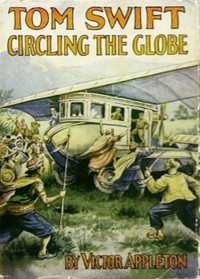
Tom Swift circling the globe; or, The daring cruise of the Air Monarch
Edition facts
The opening chapter of Tom Swift Circling the Globe introduces the story through a wager: Tom Swift’s father bangs a newspaper on his desk and bets ten thousand dollars that his son can circle the globe. This moment establishes the competitive, confidence-driven tone that runs through the excerpts. The narrative quickly moves to technical details—Tom’s craft, the Air Monarch, is described as capable of traveling on land, water, and air, with a special gas for emergency power. The excerpts show a focus on mechanical problem-solving, such as adjusting the tail rudder to take off from the sea during a storm. The catalog subject ‘Aeronautics’ is central, but the ‘Science fiction’ label is less evident in these passages, which emphasize practical engineering over speculative technology.
The Wager as a Narrative Device
The story opens not with action but with a boast. Tom Swift’s father folds a newspaper, makes a club of it, and bangs it on his desk, exclaiming he will wager ten thousand dollars that his son can accomplish the feat. This wager serves as the catalyst for the plot, framing the adventure as a challenge to be proven. The excerpt does not reveal who the bet is with or the terms, but the father’s confidence sets a tone of familial pride and public competition. The wager is a recurring motif in the Tom Swift series, often used to motivate the protagonist and raise stakes. Here, it also establishes the elder Swift as a character who believes in his son’s abilities, a dynamic that contrasts with the technical focus of later passages.
The Air Monarch: A Machine of Many Talents
The Air Monarch is described as a craft that can travel on land, water, or air, with a special gas for emergencies. Tom pulls the throttle, advances the sparking system, and tilts the tail rudder to lift off from the sea. The machine quivers as it struggles between air and water, but ultimately rises. The narrative emphasizes speed and efficiency: Tom notes the craft’s speed is necessary to make up for lost time. The excerpts show the Air Monarch as a versatile but demanding machine, requiring precise adjustments. The catalog subject ‘Aeronautics’ is directly addressed, but the craft’s amphibious and submersible capabilities go beyond simple flight, hinting at a broader technological scope that the excerpts only partially reveal.
Storm Navigation and Technical Problem-Solving
During a hurricane, Tom forces the Air Monarch to climb above the storm, reaching a calm atmosphere where the sun shines. The narrative details the struggle: the craft quivers, lightning flashes, and thunder booms. Tom orders a switch from special gas to ordinary motor fuel after gaining altitude. The focus is on practical decisions—using the wind, calculating position, and adjusting speed. Ned, Tom’s friend, assists with figures to determine distance traveled. The excerpts show that the story values technical competence and teamwork. The catalog subject ‘Adventure stories’ is evident in the storm scene, but the adventure is framed as a series of engineering challenges rather than pure action. The excerpts do not reveal the outcome of the global flight, leaving the reader to infer that further obstacles await.
The excerpts from Tom Swift Circling the Globe reveal a story that balances technical detail with adventure, driven by a wager and a versatile aircraft. Readers should note that the narrative prioritizes problem-solving over character development, and the catalog subject ‘Science fiction’ may not fully capture the work’s emphasis on practical invention. The excerpts provide a clear sense of the story’s mechanics but leave the global journey’s outcome unknown.