Uncle Wiggily on the farm
Edition facts
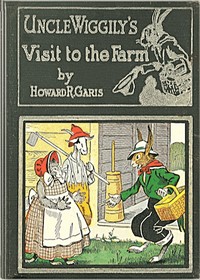
Howard R. Garis opens Uncle Wiggily on the Farm with a title that reads like a breathless summary: “How He Hunted For Eggs and Was Cause For Alarm and Bully and Bawly, the Froggie Boys.” The run-on syntax mimics a child’s excited telling, and the phrase “cause for alarm” hints at the gentle mishaps to come. Garis’s diction favors concrete, domestic verbs—gather, churn, hoe—and his characters speak in polite, slightly formal exclamations (“Oh, Uncle Wiggily! It is showering again!”). The bunny gentleman’s voice is consistently jolly and patient, even when his umbrella refuses to open.
The Rhythm of Repeated Action
Garis builds the first story around a single comic device: Uncle Wiggily’s umbrella, which the frog boys Bully and Bawly have secretly cut. The narrator returns to the umbrella at each rain shower, creating a predictable pattern that young readers can anticipate. The phrase “Bully and Bawly, splashing through the puddles” recurs with slight variation, anchoring the pranksters’ perspective. Garis varies the shelter locations—a toad stool, a bakery awning, a turtle taxicab—so the repetition feels playful rather than tedious. Each time Uncle Wiggily declares he will open the umbrella, the frog boys “eagerly watched” or “looked at one another,” building suspense from a simple prop.
Polite Speech as Characterization
Dialogue in this excerpt is uniformly courteous, even in moments of mild distress. Mrs. Twistytail says, “Oh, Uncle Wiggily! It is showering again!” and Mrs. Littletail frets, “I have my best dress on.” Uncle Wiggily responds with “a jolly voice” and reassures them with elaborate politeness: “Then let me have the pleasure of taking you home.” The frog boys speak only in short, conspiratorial asides (“We cut the wrong umbrella”), contrasting with the adults’ formal register. Garis uses this contrast to signal that the boys are up to mischief without making them sound rude. The bunny gentleman’s unfailing courtesy makes his obliviousness endearing.
Setting as a Series of Cozy Obstacles
The farm setting is sketched through functional details: a barn to crawl under for eggs, a churn for butter, a potato field to hoe. Garis does not describe landscapes; he names places only when they serve the action. The rain showers force the characters to move from toad stool to awning to taxicab, each location a brief stage for the umbrella joke. The turtle taxicab “cruising along through the puddles” adds a whimsical urban touch to the rural scene. The rainbow that Uncle Wiggily points to is the only decorative image, and it is immediately undercut by the frog boys’ scheming. The world feels safe and small, bounded by the next shelter.
Wordplay and Sound in the Prose
Garis’s prose is full of playful sounds: “splash on her nose,” “hoist it,” “splashing through the puddles.” He uses alliteration sparingly but effectively (“bunny gentleman,” “lady pig and lady rabbit”). Character names are themselves puns: Nurse Jane Fuzzy Wuzzy, Uncle Butter the goat, Mrs. Twistytail the pig. The narrator occasionally addresses the reader with a conspiratorial “you may know,” but the excerpts show Garis favoring brisk, declarative sentences. The frog boys’ names—Bully and Bawly—echo their mischievous nature without being explained. The text trusts that young readers will enjoy the sounds of words like “taxicab” and “umbrella” without needing definitions.
Readers approaching Uncle Wiggily on the Farm should listen for the rhythm of repeated phrases and the contrast between polite adult speech and the frog boys’ terse asides. The umbrella prank is the engine of the first story, but the pleasure lies in watching Uncle Wiggily’s unfailing good nature meet each obstacle. The excerpts do not reveal how the prank resolves, leaving the reader to discover whether the bunny gentleman ever learns the truth.