1

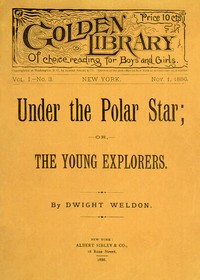
Under the Polar Star; or, The Young Explorers — Background and Themes
(0 User reviews)
791
Project Gutenberg
2020
Not confirmed
Eskimos -- Juvenile fiction; Adventure and adventurers -- Juvenile fiction; Ship captains -- Juvenile fiction; Mutiny -- Juvenile fiction; Dime novels; Poverty -- Juvenile fiction; Diligence -- Juvenile fiction; Success -- Juvenile fiction; Trapping -- Juvenile fiction; Whaling -- Juvenile fiction; Child labor -- Juvenile fiction; Stowaways -- Juvenile fiction; Buildering -- Juvenile fiction; Building, Ice and snow -- Juvenile fiction; Flagellation -- Juvenile fiction; Insurance fraud -- Juvenile fiction; Merchant mariners -- Juvenile fiction
Readers of public-domain and historical texts
Project Gutenberg digital edition
en
Edition facts
Words
45,850
Reading time
200 min
Text sections
46
The source record for Under the Polar Star; or, The Young Explorers — Background and Themes measures this digital text at 45,850 words, 3 hr 20 min estimated reading time, and 46 detected text sections.
The text analysis averages about 13.5 words per sentence, while the detected sections provide another way to judge how the source is divided.
Project Gutenberg metadata also associates the work with “Eskimos -- Juvenile fiction,” connecting these edition facts with the source record’s subject description.
Source:
Project Gutenberg record #63549
Dwight Weldon's 1886 dime novel follows three boys from Maine poverty to Arctic perils, opening with a ship carpenter carving a golden moose and escalating through shipwreck, ice fields, and mutiny.
Read the complete public-domain text at its original source.
Read on Project GutenbergThe novel begins not at sea but in a Maine workshop, where Solomon Bertram, a ship carpenter, carves a wooden moose head while poverty looms at his door. The opening line—"Chip! chip!"—establishes a rhythmic, almost hypnotic sound that anchors the first scene. This domestic hardship quickly gives way to adventure: the table of contents promises shipwreck, ice huts, stowaways, and a whaling voyage. The story moves from the carpenter's bench to the frozen Arctic, where the ship Arctic becomes trapped in ice. Readers should note how the early chapters establish the boys' resourcefulness before they ever reach the polar regions.
From Workshop to Wilderness
The first chapter, "The Golden Moose," introduces Solomon Bertram as a skilled craftsman whose "thin hand trembled" as he works. The narrative dwells on his poverty and the "grim poverty and want" hovering over his home. This is not a generic rags-to-riches setup; the specific detail of the carved moose head—a golden moose—suggests a symbolic object that may connect to later events. The chapter titles that follow—"Captain Stephen Morris," "A Daring Feat," "The Adventures of a Night"—indicate a rapid shift from domestic struggle to action. The boys, presumably including Will and Tom, are introduced through their circumstances rather than their personalities. Readers should watch for how the initial setting of the carpenter's shop contrasts with the open ocean and ice fields that dominate later chapters.
Arctic Survival and Peril
When the Arctic becomes icebound, the crew faces "all the perils of the frozen deep." The narrative describes ice floes closing in, icebergs toppling, and the ship nearly being crushed. The captain announces winter quarters, and the crew boards over the deck, making cabins "snug and warm." A key episode involves a sled expedition in search of a white bear. The boys—Will, Tom, and presumably a third—wander off from the sled while Jack and Hugo talk, scaling icebergs and exploring ice caves. Will realizes they have lost sight of the sled: "We must return, boys," he says. Tom suggests finding their way back by snow marks. This moment of separation is a turning point, leading to a series of survival challenges. The excerpt does not reveal the outcome, but the chapter titles—"Lost," "In the Wilderness," "Imprisoned by Wolves"—indicate escalating danger.
Voice and Structure of a Dime Novel
Weldon's prose is direct and economical, typical of dime novels from the 1880s. Sentences are short, action-driven, and often declarative: "The Arctic experienced all the perils of the frozen deep." Dialogue is sparse but functional, as when Jack tells Will, "Drifted, floated and blew, lad." The narrative moves quickly from one crisis to the next, with chapter titles that function as mini-summaries. The book was published as part of the "Golden Library of choice reading for Boys and Girls," priced at ten cents, and its structure reflects a serialized, episodic approach. Each chapter ends with a hook—the boys wandering off, the ice breaking up—that propels the reader forward. The catalog subjects, which include mutiny, stowaways, and insurance fraud, hint at plot elements beyond the Arctic setting, suggesting a blend of adventure and moral lessons about diligence and success.
What the Excerpts Leave Unanswered
The excerpts cover only the opening chapters and a middle section involving the icebound ship. The complete table of contents reveals later chapters set on a yacht, in Portland, and involving a character named Alan Bertram. The title "Under the Polar Star" suggests a thematic focus on navigation and destiny, but the excerpts do not clarify how the boys become "young explorers" or what role the golden moose plays. The catalog subjects list "buildering" and "building, ice and snow," which may refer to the construction of an ice hut or other structures. Readers should approach the text with curiosity about how the initial poverty and the Arctic ordeal connect to the later chapters, which seem to involve rescue, imprisonment, and a fortune. The novel's dime-novel format means plot twists are likely frequent and dramatic.
First-time readers of Under the Polar Star will benefit from paying attention to the early domestic scenes, which establish the boys' backgrounds and motivations. The Arctic episodes are the heart of the story, but the later chapters—set on a yacht and in Portland—suggest a return to civilization and a resolution of the initial poverty. The novel's rapid pacing and episodic structure make it a quick read, but the specific details, such as the carved moose head and the ice caves, reward close attention. Enjoy the journey from the carpenter's bench to the polar ice.
Reading about Dwight Weldon’s boys carving hope from Maine poverty before facing Arctic ice, I found myself thinking of another old tale, where Ned Rogers stumbles ashore on a jungle island. Both share that raw ache of being utterly small against a vast, indifferent world. The treasure hunt in Wrecked on Spider Island; Or, How Ned Rogers Found the Treasure — Themes and Context felt less like adventure and more like a quieter plea for a way home.
There are no reviews for this eBook.
There are no comments for this eBook.
Reader reflection
How did this book work for you?
Your answers remain private and are stored only in this browser.
Your progress
0
/
10
2
Did this book hold your interest?
3
Would you encourage someone else to read it?
4
What was the reading difficulty like?
5
Could you follow the author’s main argument?
6
How closely did the book connect with your experience?
7
How useful were the ideas in this book?
8
How did the reading compare with what you expected?
9
What is the main idea you are taking away?
10