1

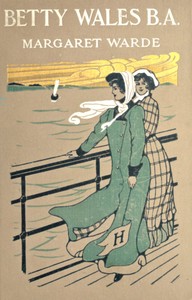
Betty Wales, B. A.: A story for girls — Themes and Context
(0 User reviews)
2145
Project Gutenberg
2022
Not confirmed
Wales, Betty (Fictitious character) -- Juvenile fiction; England -- Social life and customs -- Juvenile fiction; Young women -- Social life and customs -- Juvenile fiction; Women college graduates -- Juvenile fiction; France -- Description and travel -- Juvenile fiction; Tourists -- Juvenile fiction
Readers of public-domain and historical texts
Project Gutenberg digital edition
en
Edition facts
Words
66,984
Reading time
292 min
Text sections
23
The catalog record for Betty Wales, B. A.: A story for girls — Themes and Context provides practical reading context through 66,984 words, 4 hr 52 min estimated reading time, and 23 detected text sections.
The text analysis averages about 15.1 words per sentence, while the detected sections provide another way to judge how the source is divided.
Project Gutenberg metadata also associates the work with “Wales, Betty (Fictitious character) -- Juvenile fiction,” connecting these edition facts with the source record’s subject description.
Source:
Project Gutenberg record #68240
In this post-college installment, Betty Wales and her friends tour England, Scotland, and France, mixing ghost-hunts, a duke purchase, and a journalist's scoop. The narrative contrasts carefree tourism with the pressures of work and romance, as seen in Dick Blake's pursuit of a story and Babe's test of John Morton's diligence.
Read the complete public-domain text at its original source.
Read on Project GutenbergBetty Wales, now a college graduate, does not settle into a career or domestic life. Instead, she and her friends—the “Merry Hearts” from Harding College—embark on a tour of Britain and France, a journey that the author frames as a natural extension of their schoolgirl camaraderie. The book opens with an impromptu wedding and a going-away party, immediately establishing that these young women travel as a group, chaperoned but independent.
The excerpts reveal a story built on contrasts: the leisurely pursuit of ghosts and dukes versus the urgent work of a journalist chasing a financial magnate; the playful banter of the friends against the serious undertones of romance and obligation. Betty herself is described as “being a B. A.” when she helps a reporter, suggesting that her education is not merely ornamental but a tool for navigating the world.
Ghosts, Dukes, and the Business of Pleasure
The title of Chapter XV, “A Noisy Parisian Ghost,” hints at the book’s recurring motif: the girls’ fascination with ghosts, which began in Scotland and continues in London and Paris. This ghost-hunting is a playful, self-aware pastime—Babbie declares it her “dominant interest”—and it contrasts sharply with the more pragmatic concerns that surface. In Chapter IX, “Buying a Duke,” the friends purchase a porcelain figurine for Eleanor Watson, a joke that underscores their whimsical approach to European culture. Yet the same chapter introduces Dick Blake, a journalist who is serious about his work: he needs to find Jasper J. Morton for an interview, and the story’s outcome could mean “the biggest kind of a big beat.” The tension between frivolity and ambition runs through these episodes, with Betty acting as a bridge between the two worlds.
The Reporter’s Stake and the Magnate’s Son
Dick Blake’s presence introduces a professional urgency absent from the girls’ sightseeing. He is on a deadline, chasing a story that will earn him a “juicy fee,” and he enlists Betty’s help to locate the elusive Jasper J. Morton. Meanwhile, John Morton—the magnate’s son—is also in Europe, but his concerns are personal: he has been studying to prove his worth to his father, and he anxiously awaits a letter of approval. Babe, his romantic interest, threatens to return his pin if he shirks. These parallel plots—Dick’s career gamble and John’s filial test—ground the narrative in real-world stakes, even as the girls continue their ghost-hunts. The excerpts show that the book does not ignore the economic realities behind travel; it weaves them into the fabric of the characters’ interactions.
Betty as Mediator and Problem-Solver
Betty Wales is repeatedly cast as the one who resolves dilemmas. When Dick Blake needs information, Betty recalls the magnate’s remark about French roads, providing the clue that sends him across the Channel. Madeline later reports that “Betty’s been being a B. A. again,” implying that her college training has equipped her to think quickly and act decisively. This role as mediator extends to social situations as well: she navigates the delicate balance between helping a reporter and not taking advantage of a generous acquaintance. The book positions Betty not as a passive tourist but as an active participant in the events around her, using her education and social intelligence to influence outcomes. Her friends rely on her judgment, and the narrative rewards her resourcefulness.
Readers familiar with the earlier Betty Wales books will find this volume a natural continuation, though the shift from campus to continent changes the dynamics. The excerpts suggest a story that balances lighthearted adventure with moments of genuine tension, particularly around work and romance. Pay attention to how the author uses the travel setting to test the characters’ values and relationships, and note the recurring pattern of the group’s collective energy being channeled into both silly and serious pursuits.
Some books stay like quiet company, and that Betty Wales trip—how the girls’ laughter bounced off old stones while work and worry waited—reminded me of that feeling in The New Boy at Hilltop, and Other Stories. I still think about how easily we drift between play and pressure. The New Boy at Hilltop, and Other Stories — Inside the Classic held a similar warmth, like remembering a friend’s shy smile long after they’ve gone home.
There are no reviews for this eBook.
There are no comments for this eBook.
Reader reflection
Record your reading impressions
A brief reflection can help important ideas stay with you longer.
Your progress
0
/
10
2
Did this book hold your interest?
3
Would you recommend this book to another reader?
4
How easy was the book to follow?
5
Did the book offer a fresh perspective?
6
Did this book create an emotional response?
7
What was the strongest part of the book?
8
How useful were the ideas in this book?
9
What is the main idea you are taking away?
10