1

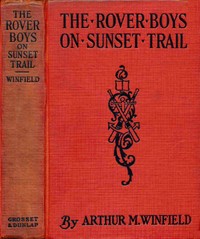
The Rover Boys on Sunset Trail; or, The old miner's mysterious message — Inside the Classic
(0 User reviews)
678
Project Gutenberg
2022
Not confirmed
Western stories; Adventure stories; Boarding schools -- Juvenile fiction; Military education -- Juvenile fiction; Military cadets -- Juvenile fiction
Readers of public-domain and historical texts
Project Gutenberg digital edition
en
Edition facts
Words
68,804
Reading time
300 min
Text sections
46
The catalog record for The Rover Boys on Sunset Trail; or, The old miner's mysterious message — Inside the Classic provides practical reading context through 68,804 words, 5 hr estimated reading time, and 46 detected text sections.
The text analysis averages about 14.1 words per sentence, while the detected sections provide another way to judge how the source is divided.
Project Gutenberg metadata also associates the work with “Western stories,” connecting these edition facts with the source record’s subject description.
Source:
Project Gutenberg record #68332
This editorial note examines Edward Stratemeyer's diction, dialogue, and descriptive choices in the ninth volume of the Second Rover Boys Series, focusing on how the author balances legal and mining jargon with the boys' colloquial banter to create a Western adventure.
Read the complete public-domain text at its original source.
Read on Project GutenbergThe Rover Boys on Sunset Trail opens not with a stagecoach robbery or a gunfight, but with a business dispute. Tom Rover explains to his sons that a Canadian promoter named Peter Garrish is trying to seize control of the Rolling Thunder mine, outmaneuvering the honest but uneducated old miner Lew Billings. This legal wrangling sets the tone for a story where the villains are as likely to wield a contract as a six-shooter. Stratemeyer’s diction shifts between the formal language of stockholder meetings and the relaxed, observant chatter of the Rover boys, creating a hybrid adventure that is part Western, part boardroom drama.
The Language of the Mine and the Law
Stratemeyer peppers the opening chapters with terms like “stockholders,” “legal aspects,” and “sixty-thousand-dollar interest,” grounding the conflict in financial stakes rather than pure physical danger. When Tom Rover describes Garrish as “a promoter from Canada and an unusually slick individual,” the word “promoter” carries a specific, slightly shady connotation in 1920s business slang. The author also contrasts this with Lew Billings, who is “deficient in education” but a “first-class mining operator.” This pairing of legal savvy versus practical know-how recurs throughout the excerpts, suggesting that the story’s central tension is as much about competence and trust as it is about gold.
The Boys’ Colloquial Observations
When the Rover boys discuss the landscape from the train, their dialogue reveals a generational and temperamental divide. Randy stretches out his arm and declares, “These open spaces are what get me,” while Andy muses that he’d “rather rove around the open places” than settle in a city. Jack counters with a teasing offer of “a bungalow on the top of Pike’s Peak,” and Andy retorts with a joke about “a bird’s nest on the top of the north pole.” These exchanges are light, almost flippant, but they serve a structural purpose: they establish the boys as restless, observant, and prone to humor even in serious moments. The author uses their banter to break up longer expository passages, giving the reader a sense of character through voice rather than description.
The Fourth of July Derailment as a Structural Device
Stratemeyer introduces a sudden train halt on the Fourth of July, spilling coffee and sending an ear of corn rolling into the aisle. The timing is deliberate: a holiday meant for celebration becomes an interruption, and the boys’ immediate reaction is to investigate. “Let’s go up ahead and take a look at things,” says Jack, and the narrative shifts from passive travel to active problem-solving. The author uses this minor crisis to transition from dialogue-heavy exposition to action, a pattern that recurs throughout the series. The derailment is not a major plot point—it is resolved quickly—but it demonstrates how Stratemeyer builds momentum through small, concrete incidents rather than large set pieces.
The Author’s Use of Parenthetical Asides and Direct Address
Stratemeyer’s authorial voice intrudes in the introduction, where he addresses “My Dear Boys” and boasts that the series has sold “over three million copies.” This direct address is a hallmark of early twentieth-century juvenile fiction, but it also serves a rhetorical purpose: it frames the story as a personal offering from the author to his readers. Within the narrative, the author occasionally inserts clarifying phrases like “as the boys had traveled westward before” to remind the audience of the characters’ history. These asides are unobtrusive but effective, creating a sense of continuity across the series without requiring prior knowledge. The result is a text that feels both self-contained and part of a larger universe.
Readers approaching The Rover Boys on Sunset Trail for the first time should pay attention to how Stratemeyer layers business terminology with the boys’ casual speech. The author’s choice to open with a legal dispute rather than a chase signals that this is an adventure where brains matter as much as bravery. The excerpts suggest a story that values competence—whether in mining, law, or observation—over mere luck. For those familiar with the series, this volume continues the pattern of mixing domestic concerns with frontier danger, but with an unusual emphasis on the paperwork of the Wild West.
The rain drummed on the porch roof while I trailed the Rover boys through that old miner's coded map, their chatter echoing off the page. Stratemeyer’s knack for making jargon feel like banter stayed with me. Afterwards, I drifted to The New Boy at Hilltop, and Other Stories — Inside the Classic, and found that same unhurried warmth, a quieter kind of belonging, settling in like the afternoon light.
There are no reviews for this eBook.
There are no comments for this eBook.
Reader reflection
Take a moment to reflect on this book
Create a short personal record of your experience with this book.
Your progress
0
/
10
2
What was your overall reaction to the book?
3
Would you encourage someone else to read it?
4
How demanding did the text feel?
5
How original did the book feel?
6
Would you like to discuss this book with someone?
7
Was the book what you thought it would be?
8
Did this book create an emotional response?
9
What changed or sharpened your thinking?
10